Table of Contents

Wednesday, December 16, 2015

Reds acquire Peraza, Schebler, and Dixon for Todd Frazier

Farewell to Todd Frazier.
Photo credit: Arturo Pardavilla III
The +Cincinnati Reds finally made their first substantial move of the offseason, trading away Todd Frazier to the White Sox for a trio of players that arrive from the Dodgers.  The Dodgers received their own set of prospects from the White Sox for their part in this three-team trade.

The deal comes on the heels of the failed attempt to trade Aroldis Chapman to the Dodgers about a week ago, which (despite protests to the contrary from the Reds) were likely derailed when information about the alleged domestic violence that he committed against his girlfriend in October.  The key player rumored to be involved in that deal was Jose Peraza, and that very player was delivered to the Reds in this deal.  Therefore, that's one way to view this trade: the Reds got their guy.

In general, the Reds have been rumored to be seeking MLB-ready prospects in return for the players they are trying to move (Chapman, Bruce, etc).  This is in keeping with Bob Castellini's assurances that this rebuild will not represent a long-term derailment of the team.  Get players who can contribute immediately, surround them with talent already in the system, keep the players already controlled long term, and you have the Reds back into contention within a few years.  That's the apparent strategy at play from the Reds' perspective.

Unfortunately, the initial reactions of observers around baseball have been almost universally poor.  While you will see praise for Jose Peraza among some prospectors, most agree that the return the Dodgers got, headlined by Frankie Montas, was superior to that of the Reds:
Let's work through the players one by one, starting with the player the Reds gave up.

Todd Frazier, RHB, 3B, 29.9 years old


I was never a big Frazier believer as he came up through.  In hindsight, I'm not positive why.  I guess his numbers were more just good-at-everything rather than spectacular at any one thing.  His AA and AAA slugging percentages were in the high-.400's rather than the .500+, his OBP was usually around .350 rather than .400.  He was always a little bit old for his level (or, at least, not young).  But he hit all the way through the minors, and held his own during his debut.  His During first full season with the team in 2012, he tied his career high for home runs in a season despite only getting 465 PA's.  And his power continued to be a surprisingly (to me) important part of his package, showing himself to be a legitimate 30 homer threat over the past two years.  Yes, he struggled in the second half last year, but at the same time he was beyond brilliant in the first half.  He did both of those things.  He's posted 4+ wins each of the last two years thanks to an above-average bat and plus fielding at a corner slot.

The White Sox will have two years of control on him left.  Next year, he's under the second year of a two year contract and will $12 million contract.  His last year of arbitration, he might earn upwards of $16 million...or maybe even a bit more, if he posts another power-heavy season like he did last year.

Steamer projects him as a 3.2 WAR player next year, and a simple .5-WAR would have him at 2.7 WAR the following year.  Assuming that we're somewhere around $7.5 million/WAR right now to replace his production via free agency, that puts his overall value at about $45 million--a $12 million surplus over his salary.  He's a very good player, and a nice asset for a club.  He should do very well in the White Sox' homer-friendly ballpark.

Jose Peraza, RHB 2B/SS, 21.7 years old


Peraza is unquestionably the headliner in terms of the Reds' return.  He entered last season as a top-50 prospect on many lists coming on the heels of a strong 2014 campaign in which he showed a high-average game with some modest doubles-power and tons of speed, swiping 60 stolen bases for the second-straight year.  But his BABIP fell back down to earth when he arrived at AAA in 2015, and with it came much of his shine.  When he was traded to the Dodgers as part of the mid-season three-team deal with the Marlins and Braves, Kiley McDaniels wrote this about him.
Compared to Luis Castillo or Juan Pierre early in his pro career, Peraza’s light has dimmed a bit in 2015 due to offensive questions, but he’s still an elite runner that’s near big league ready and can play multiple positions up the middle.
His batting line was nearly identical with the Dodgers.  Peraza's game profiled as that of a pretty limited ballplayer last year.  He could run, and he didn't strike out much.  But his absurdly low walk rate (only two qualified MLB players had walk rates under 3% last year: Jean Segura and Salvador Perez) suggests that he achieves his low strikeout rate in part by being willing to swing at just about anything; it's hard to strike out when you're swinging at the first few pitches every at bat.  Bed Badler of Baseball America, at least, disagrees, arguing that he has a legitimate hit tool and could hit for average in the majors.  But, after seeing his numbers, it's hard not to read the scouting reports and think that his supporters are just getting swept away by his stolen base totals.

If he was a defensive genius at shortstop, as one might hope for such a fast player, I could live with a limited offensive skillset in a prospect.  But most scouting reports I've read today peg him as only average at shortstop.

For a moment, I thought the Reds might hope to put him in center field to platoon with Billy Hamilton.  That could be intriguing, and at least is creative.  But Peraza is a right-handed hitter, and Hamilton's "strong" side is as a right-handed batter as well.

On the whole, while I'm trying, there's not much that I can get excited about here.

Scott Schelber, LHB COF, 25.1 years old


Schebler does not have an elite prospect pedigree.  He was a 26th-round selection by the Dodgers in 2010 out of high school, although he did get a $300,000 signing bonus to entice him away from college.  And to his credit, he produced almost immediately.  Power was his main calling card, and he showed good home run power throughout most of his minor league career.  In 2014, coming off his best minor league season for the Dodgers AA affiliate (154 wRC+), McDaniel wrote this about him:
One scout put a Brandon Moss comp on Schebler and a bat-first, lefty-hitting outfielder with a fringy to average bat and above average raw power. Schebler is listed at 6’1/208 but will actually flash plus speed at times, though his arm and instincts are below average, limiting him to left field. He doesn’t have big bat speed, so some scouts are still wart, but he fits the bill of an under-the-radar performer who could surprise.
2015 didn't go as well.  While he maintained his strikeout and walk rates against better-quality pitching in AAA, his power seemed largely to disappear.  He hit just 13 home runs and sported a .169 ISO, well below the norms of his minor league career.  Given the scouting questions about his bat, that's a worrying performance.

Nevertheless, the Reds' interest seems clear: they need a left fielder.  I'm sure someone in the Reds' front office is thinking that a platoon between Schebler and Adam Duvall might be good enough to post a couple of wins above replacement next year.  Maybe it'll work.  Or, maybe major league pitchers will tear him apart.


Brandon Dixon, RHB 2B, 23.9 years old


Dixon actually has some pedigree.  He was a 3rd-round selection in the 2013 draft.  Unfortunately, prior to the start of last season, he'd never shown any indication that he could hit at all.  He might have a some power for a middle-infielder, but he didn't walk, struck out a lot, and was well below league-average during his first two professional seasons.  In 2015, he got off to a nice start to the season when repeating high-A, slugging 11 home runs in just 193 PA's to go with improved walk rates.  Upon his promotion to AA, however, he quickly returned to the same type of hitter he'd been before.  He hit well in the Arizona Fall league, but...::shrug::  As J.J. Cooper said in C. Trent's profile of the prospects, "Dixon is a lottery ticket at best. I don’t think he would crack the (Reds’) Top 30 right now. He has some raw power, but his hit tool hasn’t come along enough to get to it."

Conclusions

I'm not very excited about this haul. What I can see in the stats don't look very impressive for these guys.  Furthermore, the consensus on the twitterer is that the Reds did not do well here.  Most writers, and especially most of their baseball executive sources, seem to strongly prefer the package that the Dodgers received, which clearly could have gone to the Reds if he wanted it.  They chose Peraza instead, so hopefully they are right about him.

I'm worried that the Reds were too focused on acquiring major league-ready talent in this deal.  With Reds owner Bob Castellini pushing to make the rebuild as short as possible, it might be that the Reds front office couldn't accept younger, but higher-upside options.  I love MLB-ready talent too, but those players come at a premium.  After all, if they're ready, that likely means that the team who controls them is planning to move them onto their own active rosters.

In the end, it's just one more frustration in a depressing offseason for the Reds.  As C. Trent noted today (and Steve Manucso and I discussed last week), the Reds had the chance to deal both Chapman and Frazier at the trade deadline last summer, and probably for a better return.  There was even a consensus that they should have been traded at the time among most observers.  And now, this might well be the best collection of prospects the Reds will acquire this offseason.  And that's depressing.

Monday, December 14, 2015

Manfred: Rose won't be reinstated

Photo credit: Lori Branham
Baseball Commissioner Rob Manfred released his decision regarding Pete Rose today.  It is well worth a read.  In an age of snap judgement, it's reassuring to read a considered, nuanced, and nevertheless decisive decision that is built upon sound reasoning and evidence.

A few key lines:
"...I note that the Bertolini Notebook shows that, contrary to his assertions, Mr. Rose did not wager on every Reds game.  Thus, Mr. Rose's wagering pattern may have created the appearance to those who were aware of his activity that he selected only those games that he believed the Reds would win."
...
"While Mr. Rose claims that he only bet on baseball in 1987, the Dowd Report concluded that he also bet on Baseball in 1985 and 1986."
...
"Even more troubling, in our interview, Rose initially denied betting on Baseball currently and only later in the interview did he "clarify" his response to admit such betting."
...
"Mr. Rose's public and private comments...provide me with little confidence that he has a mature understanding of his wrongful conduct, that he has accepted full responsibility for it, or that he understands the damage he has caused.  As I understand it, Mr. Rose has never seriously sought treatment for either of the two medical conditions described so prominently in his 2004 book and in Dr. Fong's report."
And then the money paragraph:
"In short, Mr. Rose has not presented credible evidence of a reconfigured life either by an honest acceptance by him of his wrongdoing, so clearly established by the Dowd Report, or by a rigorous self-aware and sustained program of avoidance by him of all the circumstances that led to his permanent ineligibility in 1989.  Absent such credible evidence, allowing him to work in the game presents an unacceptable risk of future violation by him of Rule 21, and thus to the integrity of our sport.  I, therefore, must reject Mr. Rose's application for reinstatement."
As many will note, the commissioner did address the fact that this decision is targeted at Rose's eligibility to be part of baseball, not whether he can be inducted into the Hall of Fame.  He makes very clear that this is the next step for Rose:
"It is not a part of my authority or responsibility here to make any determination concerning Mr. Rose's eligibility as a candidate for election to the National Baseball hall of Fame.  In fact, in my view, the considerations that should drive a decision on whether an individual should be allowed to work in Baseball are not the same as those that should drive a decision on Hall of Fame Eligibility...The issue of whether Mr. Rose should be eligible for Hall of Fame election under the bylaws of that organization presents an entirely different policy determination that is focused on a range of considerations distinct from the more narrow questions before me...Thus, any debate over Mr. Rose's eligibility for the Hall of Fame is one that must take place in a different forum."
He's not going to work in baseball again.  But there is some chance that he might become eligible for the Hall of Fame.  I'm glad that this was made so clear, and I think this is clearly where this conversation should turn.  I've made it pretty clear over the years that I'm not a fan of Pete Rose.  I think he's pretty shady, at best, and there's a non-zero chance that he's a total scumbag.  Nevertheless, if we think of the Hall of Fame as a museum recognizing important moments and figures in Baseball History, I don't think there's any question that Rose deserves induction...or that his fall from baseball deserves to be chronicled and highlighted.

Tuesday, November 24, 2015

The biggest Reds news of 2016: their TV deal is about to expire

Photo Credit: Lynn Friedman
It's a challenging time for the Cincinnati Reds.  Coming off back-to-back losing seasons, there doesn't seem to be much reason for immediate optimism.  Even the front office is no longer bothering to predict great things.  In a recent interview, Reds President Walt Jocketty called 2016 a "transition year."  The front office is usually the last to admit they're not bound for contention, so we shouldn't expect much from the team next year.  All signs point to a fire sale this winter, and the question is more "how much" than "whether" in terms of the Reds converting their higher-priced veteran talent into cheaper and controllable prospects.  I'm hopeful that the next year will bring some exciting trades, at least.  I do worry that the Reds waited too long to sell off some of their top guys.  Chapman has only 1 year of control left and thus won't command the return the Padres just got for Craig Kimbrel.  Frazier probably peaked last summer.  Et cetera.  But there's still value to be had (and dealt).

There is one acquisition sitting on the horizon, however, that seems guaranteed to bring a nice boost to the Reds' bottom line: their television contract expires after next season.  Baseball's TV bonanza started, more or less, when the Dodgers received their other-worldly TV contract a few years back.  Ever since, we've seen team after team secure outstanding contracts that substantially boost revenues.  While there has been some cause for concern that this bubble might someday burst, there hasn't been any indication of that so far as I've seen.

Currently, the Reds' TV contract with FSN Ohio is reportedly for about $30 million per year.  That figure stands to increase with the new deal, but not to the tune of anything approaching the $8+ billion contract (total) the Dodgers received.  In fact, it might be laughably smaller: Cincinnati is the smallest TV market in all of baseball, according to Nielson's 2014-2015 Local Television Market Universe estimates:

Designated Market
Area (DMA)
TV Homes
% of US
1. New York
7,442,270
6.539
2. Los Angeles
5,523,800
4.854
3. Chicago
3,477,250
3.055
...
...
...
21. St. Louis
1,226,860
1.078
22. Pittsburgh
1,173,320
1.031
...
...
...
35. Milwaukee
893,210
0.785
36. Cincinnati
876,290
0.770

This improves, of course, if one adds Indianapolis (#27 with 1,082,690 homes) and Louisville (#49 with 656,900 homes) into the Reds' territory.  I'm not positive whether those packages would be part of the same deal or not.  Probably?

In any case, it remains to be seen how much extra money this new deal might provide the team.  An estimate a year and a half ago had the deal at $75 million.  I don't have any way to judge how accurate that is, but if true it would provide the Reds an extra $45 million to play with per season.  One has to expect that not all of that will make it to the team payroll, but it should still pay for most of Joey Votto's and Homer Bailey's contracts, which collectively range from $41 million in 2017 to $48 million in 2019. Effectively wiping those deals off the books, while still permitting the Reds to (hopefully?) benefit from their contributions on the field, would be huge.  The Reds have seemed pretty much at maximum budget from the moment that Homer Bailey signed his extension.

My hope is that they at least see an increase of $20-$25 million in their TV deal, which would be enough to cover Joey Votto.  Getting that money back to play with the rest of the roster could net them 6-7 wins per year in free agent salaries, and even more value if invested in young, extendable talent.  Time will tell.

...of course, the problem is that it's unclear who those young, extendable talents might be.  Anthony DeSclafani?  Eugenio Suarez?  Jesse Winker?  Robert Stephenson?  Some soon-to-be-acquired talent?  It remains to be seen.  But the Reds clearly will need a major infusion of talent to get back to being competitive with the likes of the Cardinals, Cubs, and Pirates.

Hat tip to a commenter on this article at fangraphs, who pointed out the Nielson DMA ratings.

Wednesday, November 04, 2015

Reds promote Dick Williams to GM

The Reds followed pattern that has become commonplace in baseball front offices over the last several years by promoting former Assistant GM Dick Williams (not that Dick Williams) to the role of General Manager, with Jocketty staying on as the President.  This is the new model that we're seeing around baseball, with similar arrangements in place with Mark Shapiro in Toronto, Andrew Friedman in Los Angeles, and, of course, Theo Epstein in Chicago.  In many cases, the President retains many of the authorities that once were under the purview of the General Manager.  For example, final decisions on the Blue Jays transactions will be controlled by Mark Shapiro, which was the main reason that Alex Anthopoulos cited for not returning to the Jays following their outstanding season.

The rationale typically cited by outside observers when these kinds of moves are made is that they provide a way for teams to retain talented assistant general managers within an organization when they are at risk of securing a general manager job elsewhere.  By giving them the title of GM, you make staying within your organization more appealing, even if it's not the traditional GM job as chief decision-maker.  Teams often have more than one assistant GM, and so this is a way of formally recognizing the President's chief lieutenant with an improved position title.

In the Reds case, it seems to be a bit more honest, though: while Jocketty will retain decision-making this year, and Williams is being granted the GM title for now, the expectation is that Jocketty will step down after 2016 into an advisory role.  At that time, Williams will take over a traditional GM role, wielding full power to control transactions and shape the ballclub.  Whether the Reds will hire another President to replace Jocketty and oversee Williams is an open question, though they seem to be indicating that this is not the plan.

There are some things to like here.  Per C.Trent's article, Williams has a background in investment banking and private equity.  Those are fields dominated by those who are effective in using data-driven approaches to make decisions.  I just recently started reading Jonah Keri's The Extra 2%, which profiles how the trio of Stuart Sternberg, Matthew Silverman, and Andrew Friedman made the transition from similar Wall Street backgrounds to running the Tampa Bay Rays.  It's hard not be excited by the prospect of the Reds being run by someone who has similar principles to Friedman's, with a strong emphasis on analytics as a way to meld statistical and scouting information.  True to form, that was one of Williams' first talking points today:
"We have some of the best scouts in the game so I would never say we are not heavily dependent on scouting. At the same time, we're doing everything in our power to grow our analytics initiatives," Williams said. "We're right up there with the other teams. We don't talk a lot about it because it really doesn't get you anywhere to let information out there publicly. We will be continuing to invest more and more in our analytics. That's just the nature of the business right now. I'm very much a proponent of combining the analytics and the scouting to get to the right answer."
That's saying all the right things to my ears.  And he's right that the Reds do have an analytics department.  Sam Grossman has said a few interesting things in public over the years, and I noted that the Reds had hired intern Lewie Pollis for a time.  How much they actually make use of those analytics is a question, but I will say that I haven't seen many recent, substantial moves (aside from the extensions of Votto, Phillips, and Bailey) that clearly ran contrary to a data-driven approach.  The Latos and Simon trades last winter looked good at the time and still look good, with Anthony DeSclafani and Eugenio Suarez looking like useful pieces for years to come.  The trades this summer seemed to do what they were supposed to do: net a number of quality players, albeit almost all pitchers, to enhance the farm system.  They probably didn't trade enough of their players last summer, but the moves they've made have looked good.  I'm not sure I buy that the Reds are "right up there with the other teams" in terms of implementation and development of analytics though I guess it depends on what teams.  Pirates?  Cubs?  No way.  But I'd buy that the Reds could be close to a median ballclub on this.

There are some other things that aren't as enticing to me.  Williams is the grandson of former Reds owner William Williams (hat tip to Red Reporter), and there are two other Williams-es near the top of the executive office roster: Chairman Joseph Williams and Vice Chairman and Treasurer Thomas L. Williams.  Now, one can be positive about this and see this as the Williams' being a great Reds' family who are at the core of the business.  But, on the other hand, you could view this as just straight-up nepotism.

Can we really argue that Dick Williams is one of the 30 best candidates for this position, given the advantages he had to gaining and maintaining his position?  I don't know.  I won't blame the guy for his family, but I'm not comfortable giving him credit for it either.  There is an opportunity cost here, in that the Reds aren't giving themselves a chance to hire from outside the organization and bring in a top-tier candidate.  Maybe Alex Anthopoulos (to pick a name of an available, successful GM) isn't a better option, but the Reds didn't even give themselves the chance to find out.

No matter what I think of it, though, Dick Williams is now, or soon will be, our guy.  We get a long goodbye with Walt Jocketty (I hate long goodbyes), and we get to know Williams gradually.  I'll always cheer for the Reds, so I'm cheering for this to work.  Good luck, Walk & Dick.

Wednesday, October 21, 2015

My Playoff Team Previews

At this point, I've profiled all four of the remaining playoff teams.  Here's a handy set of links to each one.

American League


National League

If the Cubs advance to the World Series...which, at this moment in the 7th inning of game 4, seems pretty unlikely...I'll probably run another profile on them.  But this might be the complete set.

For the record, I'm rooting for the Blue Jays in the American League.  I like the Royals and all, but the Blue Jays are too much fun.  I was pretty stoked to see them hang in there tonight for at least one more game.  Tulo seems like he's heating up.

In the National League, I'm not sure.  I have a hard time rooting for Daniel Murphy.  But I love Curtis Granderson.  I love the Mets' young pitching.  But I like the Cubs' young hitters just as much.  I instinctively feel drawn to the Cubs over the Mets, but my soul can't accept rooting for the Cubs.  So, I'm just enjoying the NLCS.  I'm not sure who I'll root for if the Royals advance to the World Series.  It'd be Cueto on days he pitches.  Other than that, I'll have to wait and see.

Tuesday, October 20, 2015

2015 Playoffs: The Toronto Blue Jays

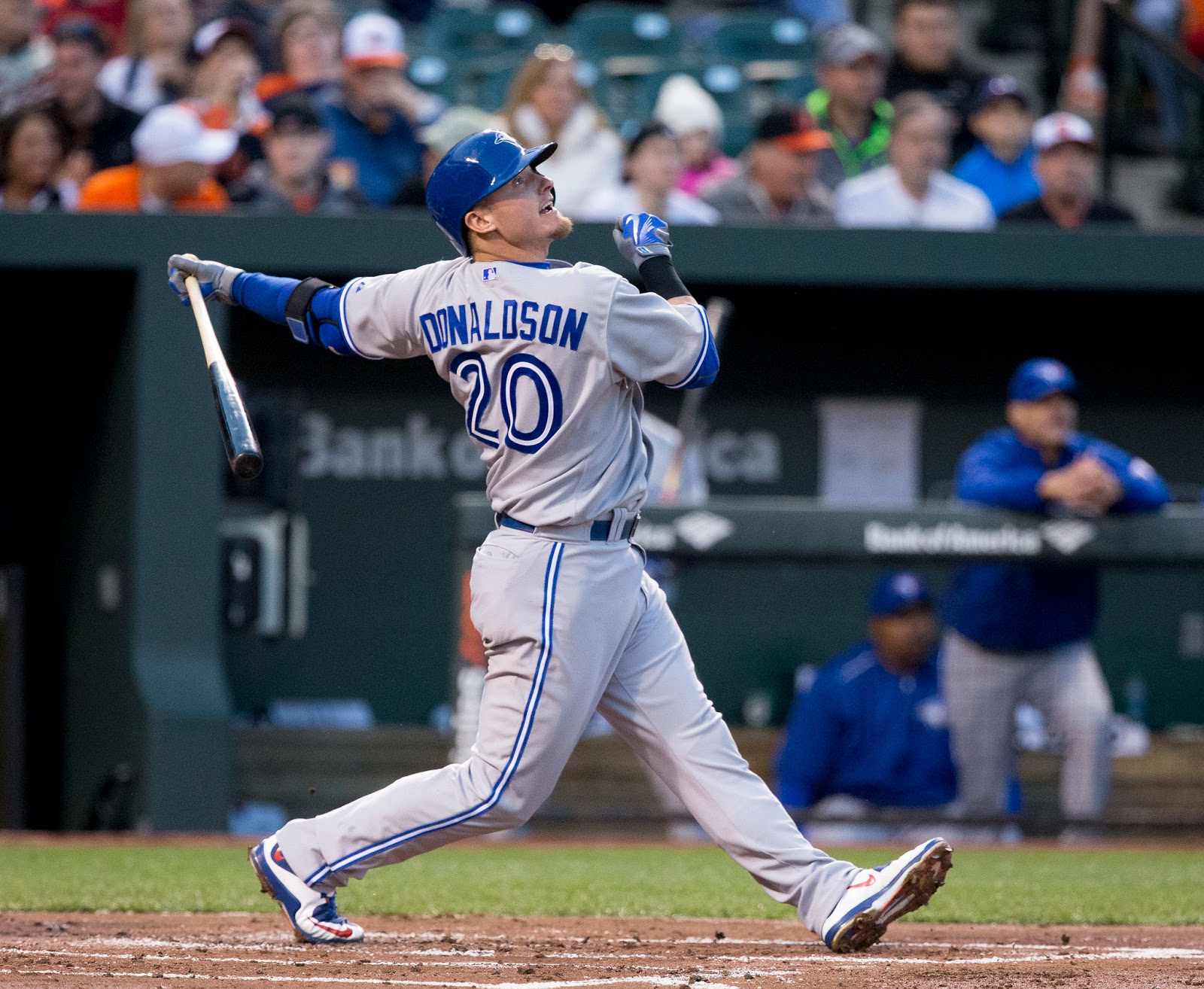
Josh Donaldson leads the Toronto Blue Jays' collection of very good, yet very surprising hitters.
Photo Credit: Keith Allison
(note: this was written in between games 3 and 4.  As it goes live, I have no knowledge of the outcome of today's game...edit: and after watching it, all I can say is wow.  Cliff Pennington pitching in October?  Really?)

After several consecutive years of enticing promise and ultimate failure, the Toronto Blue Jays finally reached the playoffs this year for the first time since 1993.  It was an exciting season from an outsider's perspective: the Jays basically seemed to be treading water through the end of July, once again hovering around .500 despite preseason optimism.  On July 28th, they were 50-51, and 8 games behind the NL East-leading Yankees.  But the front office was active at the end of July, netting the Jays both David Price and Troy Tulowitzki near the trade deadline.  And while you can't attribute it entirely to those moves (Tulo did not hit well, and missed half of September with injuries), they proceeded to go on an unbelievable tear as the calendar turned to August, including an 11-game winning streak that took them all the way to first place.  After another couple of weeks of back and forth, the Jays took the division lead for good, and by mid-september had pulled well away from the Yankees.  It really was the stuff of storybooks:


They "only" won 93 games, but this looks like a monster team.  They led the league in position player WAR, despite only average fielding ratings.  Their offense was just unreal.  They were better at almost every aspect of offense than anyone else.  Cumulative measures like wRC+ and wOBA?  They were the outlier leaders.    On-base percentage?  Best.  Slugging?  Best.  ISO?  Best.  Home runs?  Best.  Walk rate?  #2, barely behind the Dodgers.  Strikeout rate?  5th-lowest (which is amazing given their power).  Baserunning?  5th best, just behind the Reds.  Added to that offensive greatness is a solid-enough rotation (though note the xFIP-ERA split...doesn't really follow from their fielding data, but sequencing and knuckleballers, maybe?) and an effective bullpen (despite the turnover).  The result?  A really good team.


Position Players

This is the best collection of position players on one team that I've seen in quite a while.

The Josh Donaldson trade of this past offseason continues to be one that confuses me.  The justification, of course, was that Oakland thought that they could acquire a reasonable approximation of Donaldson in Brett Lowrie, along with a nice set of young arms, in exchange for their MVP-candidate Donaldson.  Maybe they thought he was bound for a significant regression.  Ultimately, Donaldson went on to have the best season of his career, and is basically tied with Mike Trout for the WAR-based AL MVP honors (I'd give the nod to Donaldson, just for variety's sake).  And he's still under team control for (I think?) another three seasons.  Pretty big miss by the Athletics.

The Jays added Donaldson's brilliance to the "typical" seasons by Jose Bautista and Edwin Encarnacion (hurray for EdE!).  Those two will go down as two of the most amazing transformations by batters in baseball history.  Both were former mid-tier prospects.  Bautista had basically been a non-factor in his early goes at the league. Encarnacion showed some promise early in his career with the Reds, but seemed to have petered out.  Both were plagued by severe fielding problems at third base.  And both were basically waiver-bait.  Toronto picked up Bautista for a player to be named later in a mid-August trade in 2008.  They originally did trade for Encarnacion (from the Reds, of course) in 2009, but later let him go via waivers to the Athletics in 2010, only to sign him again a month later into that offseason.  Both players somehow, almost magically, took an enormous leap forward with their offense that easily overcame their defensive struggles.  They are the kind of player that I will always be at least a year behind the public in embracing and believing in.  For that, I find them frustrating.  But at the same time, I love them for it: players with pedigree can always take a big step forward.  And they are the ultimate counter-point to the arguments against players trying to swing hard and pull the ball: that very approach is what allowed them to take that step forward.

And then there's the ever-excellent Russell Martin.  He may have slipped a bit from his career year with the Pirates last year, but he remains an excellent hitter and an outstanding defender (#7 on the catcher framing board this year at +12 runs).  Why the Jays would start Dioner Navarro in a playoff game is beyond me, and that's not a dig against Navarro.

Right there with Bautista, Encarnacion, and Martin on the WAR leaderboard is Kevin Pillar, who has been the big surprise to me this postseason.  Himself a mid-tier prospect, he had a really nice season.  He previously seemed to have a reputation as a platoon-type guy, a lefty-masher, who could hold down center field in a pinch.  This year, thanks to good-enough offense along and superb defense, he cashed in a 4+ WAR year in his first full season as a starter.  His on-base skills could be better, but he has nice power for a speed-and-field oriented outfielder, and has been hot in October.

So, with those five in hand, this is already an excellent team.  Troy Tulowitzki, yesterday's home run (and my long-standing man-crush) notwithstanding, may be more of a piece for the future than an immediate solution.  Tulo is apparently playing hurt, and while he is clearly still capable of making nice plays in the field, his bat been roughly average for a shortstop this year, with a huge drop-off in his walk rate.  As I wrote back in July, that's weird.  Perhaps because it is known that he's not himself, he has seen more pitches in the zone this year, and has increased his swing rate on both those pitches and pitches out of the zone (with poorer contact rates to boot).  I'd like to think that the home run was a sign of good things to come, but the most likely scenario seems to be

The rest of the team is a little scrubby.  Ryan Goins is having a great postseason, but on the season demonstrated himself as a good-fielding second base option with an at-best adequate bat.  Left field has been a rotation between the all-fielding, light-hitting Ben Revere and the all hitting, awful-fielding Chris Colabello (Colabello, it should be noted, is an amazing story: he played independent ball for nine years--nine years!!--before finally getting a shot in pro ball with the Twins.  Now, he's starting at first base in the NLCS).  Justin Smoak didn't fare much better in hitting-friendly Toronto than he did in pitcher-friendly Seattle, and shares time with Colabello at first base.  But when you have the stars this team has, you can afford a few positions with lower production.

Starting Pitchers

Mid-season, this was where the Blue Jays really seemed to struggle.  But the trade deadline brought them a rental of David Price, who has been masterful in Toronto.  And Marcus Stroman returned late in the season from an ACL injury, and has picked up where he left off as a promising top of the rotation starter.  Now, suddenly, the Blue Jays aren't looking so bad.  We know Price as a fairly prototypical top-tier pitcher, with a combination of both stuff and control.  Stroman is fun because he is more extreme: while his strikeout rate isn't much to look at, he doesn't walk batters and induces a tremendous ground ball rate.  If he qualified (and at 27 IP, he certainly does not), his 64% ground ball rate this year would rank second in baseball behind only Brett Anderson.

The remaining postseason starts seem to be slated to aging (or ageless?) knuckleballer R.A. Dickey and my man Marco Estrada.  I won't even try to offer analysis of Dickey, other than to note that his strikeout rate fell quite a bit this year (and I'm not even sure if that's a bad thing...probably?).  Estrada has long been a favorite of mine because I felt he was overlooked, and I had great success with him in my fantasy league one year.  He doesn't throw hard, but has good breaking stuff and historically has posted good strikeout rates.  He is an extreme fly ball pitcher, and seems like the kind of guy who could go from something to nothing almost overnight.

Bullpen

Despite posting good numbers overall, the Toronto bullpen was much-maligned this year.  Nevertheless, they seem to have pieced together a decent staff at this point.  Roberto Osuna was solid in his role as the closer, and failed starters Liam Hendricks and Brett Cecil (now injured) turned in excellent seasons.  The quartet of Aaron Sanchez, LaTroy Hawkins (picked up in the Tulo trade), Aaron Loup, and Mark Lowe round out the rest of the staff, and all turned in solid performances in limited work.  It's probably the weakest part of the team, and didn't inspire confidence last night.  But everyone throws hard, most of them get good strikeout rates and avoid walks, and generally look pretty solid.  I don't see the pen as particularly problematic.

All told, this is my favorite team in the postseason.  I love--love!--their offense, and their pitching seems competent enough to play in October.  I don't know if they are the best team in October, or if they match up well to some of their competition.  Their lack of a quality left-handed bat might make them struggle against a team like the Mets, for example.  But they are unquestionably a fun team to watch, and have already turned in some amazing moments the postseason.  I'm hoping there's plenty more to come.

Monday, October 19, 2015

2015 Playoffs: The New York Mets

Curtis Granderson had his best season since 2011, leading the Mets in Wins Above Replacement.
Photo Credit: Keith Allison
The Mets were a team that really flew under my radar this season.  When they faced the Reds in Late June, they had just fallen behind the Nationals for the division lead.  For their part, the Nationals seemed to be heating up, and were the heavy favorites to win the division in the preseason.  Therefore, this seemed like a classic case of an over-performing Mets team that was in the process of regressing back toward .500 where they seemed to belong.  I didn't expect that by late September, when the Reds faced them again, they would be at the top of their division and sailing into the playoffs.

And yet, as I write this, the Mets have finished off a talented (if under-performing) Los Angeles Dodgers team in the division team, and are currently up two games to none of the young and exciting Chicago Cubs, having toppled both Jon Lester and Jake Arietta.  They are the favorites to represent the National League in the World Series.  It's high time to take a look at this team: are they just on a good run, or is this a legitimate, championship-caliber ballclub?

The most impressive offering featured by the Mets is unquestionably their outstanding young starting pitching.  While I am crushed by the lack of a Bartolo Colon start, the trio of Jacob deGrom, Matt Harvey, and Noah Syndergaard is about as good as it gets among playoff teams.  They matched up to Clayton Kershaw and Zack Greinke very well, and seem set to carve up teams in what remains of the playoffs just as they've done all season.  The Mets are otherwise solid everywhere else: they hit pretty well, field pretty well, and have a solid bullpen backed by an excellent closer.  In short, they're a team that's really good at one important thing (starting), and a team that has managed to avoid having holes anywhere else.  That's a good recipe for success.

Position Players

Despite the completely avoidable and frustrating loss of Ruben Tejada, and the loss of Juan Uribe just before the playoffs began, the Mets look really solid top-to-bottom here.  David Wright came back just in time to mitigate the loss of Uribe, and Wilmer Flores, who began the season as the Mets' starting shortstop, hit just as well this year as Tejada while posting solid fielding numbers.  And the team still has depth: with the acquisition of Yoenis Cespedes, Michael Cuddyer has shifted into a platoon with Lucas Duda, whereas Juan Lagares offers a fielding-based platoon option with Michael Conforto in left field.

Otherwise, the Mets have gotten solid to above-average seasons from everyone involved.  It's really fun to see Curtis Granderson, a favorite of mine since his time with the Tigers, having a great season once again as a 34-year old.  And man, Yoenis Cespedes has been amazing.  The vast majority of his fielding totals come in left field rather than center field, but I've seen little to indicate that he can't be passable in center.  He has been a force with the stick since arriving in New York, but (thanks to fielding numbers) posted 4 of his 6.7 wins with the Tigers.  He's having a fantastic contract year, easily his best ever, slugging 35 home runs and seeing only very mild BABIP inflation that offsets the decline in his already-low walk rate.  I don't think I'd pay for more than 3.5ish wins for him as a free agent, and he's already 30 years old, but he's a tremendous source of right-handed power and quality fielding.

One shouldn't overlooked Michael Conforto, either.  The left-handed side of the Mets' outfield platoon posted 2.1 WAR after rising to the majors in his first full professional season.  There's but a lot of hype about Kyle Schwarber of the Cubs, and justly so.  But Conforto, just 22, has done nothing but hit since signing in last year's draft, and is a guy who could still contribute in a big way to the Mets' success this postseason.

One other mid-season addition, in the form of a return from injury, was Travis d'Arnaud.  d'Arnaud has long been a feature near the top of the catcher framing lists, and this year was no exception.  He also had an excellent season with the bat, finally getting his BABIP over the .280 mark for the first time in his MLB career, while slugging a very impressive 12 home runs in 268 PA's.  How incredible is the R.A. Dickey trade looking for the Mets, now that both Syndergaard and d'Arnaud have blossomed at the MLB level?

With the additions of Cespedes and Conforto, and the return of d'Arnaud, this offense is probably better now than they have been all year long.

Starting Pitchers

Wow, right?  Between Jacob deGrom, Matt Harvey, and Noah Syndergaard, the Mets have three ptichers who all throw super-hard, post superb strikeout numbers, and do not walk anyone.  Their repertoires look pretty similar too, at least one the surface: hard fastballs, quality breaking stuff, and effective change-ups.  Oh, and the #4 starter, Steven Matz, is another 24-year old who throws 94 as a left-hander, while posting peripherals that were almost as good as the elite.  It amazes me that, on a per-inning basis, Matt Harvey arguably had the third-best season among this group.  And he's still throwing, despite his oh-so-controversial innings cap.

If you ask just about any general manager to describe the qualities of a dream rotation that you can build a club around, this would pretty much have to be it: young, hard-throwing, good command, and under team control for years to come.  What else can you say about them?  I just hope they can all stay healthy.

Bullpen

I didn't realize how good Jeurys Familia is.  He throws hard and avoids walks, yes.  But the most impressive thing is that he does that while simultaneously posting outstanding walk rates.  Here's a good insight into why from Eno Sarris last night:
Sheesh.  He also throws an excellent slider that people can't hit:
I haven't heard him described as an "Elite Closer," but that's what he looks like to me.

The rest of the bullpen also looks pretty solid.  Tyler Clippard has never thrown super-hard, but has excellent classes and a ridiculous change-up that always induces a lot of whiffs.  He has always dealt with an extreme fly ball rate without giving up a ton of home runs, a trend that has continued this season.  Addison Reed seems somewhat diminished since he broke in with the White Sox, but at the same time he has patched what had been the biggest hole in his game: he used to be an extreme fly-ball pitcher, and now he's getting a respectable number of grounders.  Hansel Robles is the hard-thrower among their late-inning guys, and has been effective.  They don't have a huge lefty reliever, but Jon Niese has been used in that role this post-season with very good success.

This Mets team hasn't just gotten lucky.  They are a good team that has gotten better as the season has gone on, thanks to a few key acquisitions, young player promotions, and a few key players returning from injury.  It's hard not to look at this team and be impressed.  In my view, they match up very well against all the remaining playoff teams.  If they make it past the Cubs (still two games to go), they have the power right-handed pitching to handle the Blue Jays.  They have the roster depth to handle the Royals.  It could be a fun team to watch this month.