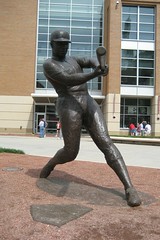
Did Dolf Luque have the best pitcher season in Reds history? By WAR, yes, you can argue that he did. Image via Wikipedia
The following is a WAR based looked at the Reds best pitcher seasons of all time and a sequel to this look at the 15 best Reds hitter seasons. The WAR pitching metric includes some interesting adjustments – particularly an adjustment for the defense. Pitchers who pitch behind a great defense (which were a key feature of the 39-40 Reds and the Big Red Machine) will find some of the runs they saved credited to the defense, while pitchers who labor with a lousy defense behind them (think Aaron Harang in 2007) get some extra credit.
If we included all years back to 1876, 7 of the top 9 Reds pitcher seasons would belong to 19th century pitchers. The differences between 19th century baseball and baseball of the early 20th century were huge, and most of those differences revolved around pitcher usage. The 1882 Reds (which won the American Association with a 55-25 record) featured a three man pitching staff, and two of those (Will White and Harry McCormick) combined for 97% of the team’s innings pitched. White made 2/3 of the team’s starts, went 40-12, and posted a team record 12.2 WAR. If you accept the WAR totals without any adjustments, you have to believe the greatest players of all time were all 19th century pitchers. For the purposes of this ranker, I will use a 1900 cutoff, and with a tip of the cap to Will White, Billy Rhines, Tony Mullane and the other Reds 19th century greats, lets take a look at the top 15 Reds pitching seasons since 1900.
15 – Bucky Walters 1940 – 6.4
Bucky Walters had a remarkable career, coming up with the Boston Braves in 1931 as a light hitting third baseman. He converted to pitching with the Phillies in 1935, and he promptly led the league in losses in 1936 despite an ERA+ of 106. Acquired by the Reds in mid 1938, he blossomed into a star for the 39-40 team, as he led the league in wins, ERA, and fewest hits/9 in both seasons. His 1940 season was the best in the National League, and he added two complete game wins in the World Series against the Tigers.
14 – Noodles Hahn 1901 – 6.5
Hahn was the first of a long line of Reds pitchers that had brilliant but injury shortened careers. Despite pitching only 7 seasons, he has the highest total WAR for any Reds pitcher. In 1901 at age 22, Noodles completed 41 of 42 starts, led the league in strikeouts, and was the third best pitcher in the league (behind Christy Mathewson and Vic Willis).
11T – Mario Soto 1983, Jim Maloney 1966, Fred Toney 1915 – 6.6
Speaking of brilliant but injury shortened careers, Mario Soto and Jim Maloney are tied for 11th with their second best seasons by WAR. Soto ranked second in the majors in WAR in 1983, led the NL in strikeouts, complete games (18), and ranked second in strikeouts and in the Cy Young vote behind John Denny. Over a five year period from 1981-1985, Soto made 162 starts, completed 63 of them, tossed 1200 innings and was essentially done as an effective pitcher just as the Reds were becoming a contender. In 1966, Maloney had “only” the 4th best WAR in the NL, but it wasn’t exactly an embarrassment to rank behind Sandy Koufax, Juan Marichal, and Jim Bunning. From 1963 – 1969, Maloney averaged 4.9 WAR per season, but in his second start in 1970, he tore his Achilles tendon and was finished just as the Reds were becoming a contender. Fred Toney’s 1915 was one of the great fluke years by a Red pitcher – he was a waiver find that went 17-6 with a 1.58 ERA for a seventh place Reds team. Using the neutralized pitching tool on Baseball Reference, his season translates to 19-4 with 2.13 ERA in 2008 at GABP.
9T – Gary Nolan 1967, Noodles Hahn 1903 – 6.8
Gary Nolan was the Reds first round draft pick in 1966, and made the team as an 18 year old in 1967. He promptly posted one of the greatest seasons ever by a teenage pitcher, going 14-8 with a 2.58 ERA and 206 strikeouts in 226 IP. He ranked 2nd in the majors in WAR behind Jim Bunning, 4th in the league in ERA and strikeouts, and in a memorable no decision on June 7th, he struck out 15 Giants (including Willie Mays four times) in 7 2/3 innings. His season translated to 2008 would have been 17-7, 2.97 ERA with 198 strikeouts in 218 IP. Granted, it was a pitchers era, but at that time Crosley Field was one of the best hitter parks in the NL. Imagine if Homer Bailey had come up in 2005 (he spent the year in class A Dayton), immediately placed among the league leaders, and struck out Albert Pujols four times in a game – that is what Nolan accomplished as a teenager in 1967.
Nolan was another great “what if” among Reds pitchers, and probably would have benefited more from modern pitcher usage (and modern medicine) than any other in Reds history. He struggled with injuries in 1968 and 1969, and then was the Reds best pitcher from 1970-72, throwing 671 IP in his age 22-24 seasons. However, the workload took its toll and he missed almost two years with injuries. He came back in 1975 and made the transition from great power pitcher to an extreme control pitcher and was a key rotation member of the 75-76 Reds. In 1976 he gave up more home runs (28) than walks (27) but by age 29, his career was finished.
8 – Mario Soto 1982 – 7.0
Mario Soto was like Aaron Harang, only better. Both were durable power pitchers, with good control being offset by giving up the long ball (Soto led the league in homers allowed 3 times in a five year span). The 61-101 1982 Reds remain (as of this writing) the only team to lose 100 games in franchise history, and one has to wonder how much uglier they would have been without Mario. He ranked second in the league in strikeouts, 4th in ERA, and 3rd in WAR behind Steve Rogers and Joe Niekro. But with no run support (18 starts where the Reds scored 3 or fewer runs), Soto ended up with a 14-13 record and in an era when W-L records dictated the Cy Young voting, Soto ranked 9th.
7 – Bob Purkey 1962 – 7.2
Perhaps the biggest surprise in the top 15, Bob Purkey was a unique pitcher. He used a knuckleball, but was not a knuckleball pitcher. He mixed it in with a fastball, curve, slider, and sinker and relied on his defense and control. In 1962 he went 23-5 with a 2.81 ERA in 288 IP for a Reds team that was considerably better than the 1961 pennant winners, but still finished third. His 7.2 WAR was second best in baseball (curiously trailing Turk Farrell of Houston, who posted a 3.02 ERA in 241 IP for the season). Purkey had a number of other solid seasons, and was a worthy selection of the Reds Hall of Fame in 1974.
5T – Bucky Walters 1939 and Noodles Hahn 1902 – 7.7
If you look at the standard stats, Bucky Walter’s 1939 season looks like the best season by a Reds pitcher in history. He went 27-11 with a 2.29 ERA in 319 innings, and won the NL MVP and the pitching triple crown (although it only took 137 to tie for the league lead in strikeouts). Bill McKechnie put together a tremendous defensive infield (Frank McCormick, Lonnie Frey, Billy Myers and Billy Werber combined for an estimated 40 runs above average in Total Zone) and Walters took full advantage. He was wild (109 walks in 1939 or 3.1 per game in an era when the league leaders would walk about 1 per game) but by allowing very few hits thanks to a great sinker and infield defense he was still very effective. He was the second best pitcher in baseball in 1939, trailing only Bob Feller.
WAR sees 1902 as Noodles Hahn’s best season, when he posted a ridiculous 1.77 ERA in 36 starts (completing 35 of them) for a mediocre Reds team. His 170 ERA+ was second in the league behind Chicago’s Jack Taylor, who also edged Hahn in WAR that year. Over a 4 year period from 1901-1904, Hahn completed 143 of 146 starts, but he was out of baseball by age 28.
4 – Jim Maloney 1965 – 8.0
Maloney was a classic power pitcher, ranking in the top three in the league in strikeouts per 9 innings nearly every year from 1963 – 1968 but also walking more than his share (including 110 in 1965). The 1965 Reds were a great offensive team (leading the league in runs scored by over 100 runs), but Maloney was the only starter on the team with an ERA better than league average. Some highlights from his season:
4/19 – In his first start of the year, Maloney gives up only one hit (a single by future Red Denis Menke leading off the 8th inning) in a 2-0 win.
6/14 – In the greatest start in team history during the Retrosheet era (game score of 106), Maloney holds the Mets hitless for 10 innings, then gives up a home run and single in the 11th. Jim’s line for the 1-0 loss – 11IP, 1 ER, 18 strikeouts and 1 walk.
8/19 – Maloney had to be thinking “not again” when he held the Cubs hitless in the first nine innings at Wrigley. In the top of the 10th, Leo Cardenas homered to give him a lead, and he closed out the shutout and no hitter in the bottom of the 10th. This one wasn’t as clean as the loss in New York – Maloney struck out 12 while walking 10.
9/1 – A five hit shutout against Milwaukee, featuring 12 K’s and only 1 walk.
Thru his age 29 season, his most similar player list reads like a who’s who of great power pitchers (Koufax, Carlton, Jenkins, Dwight Gooden and Jim Palmer are all on his top 10 list), and one has to believe that had has career lasted into his late 30’s he could have added considerably to his win total with the Big Red Machine behind him. Even with the shortened career, WAR sees him as the greatest Reds pitcher of the last 75 years in total WAR.
3 – Ewell Blackwell 1947 – 8.3
Signed as a 19 year old by the Reds in 1942, Blackwell had a cup of coffee with the Reds before joining the service for the duration of the war. A 6’ 6” lanky righthander, Blackwell combined a great fastball with an unusual sidearm motion, and in 1947 he was incredibly dominant for a 5th place Reds team that went 73-81. Blackwell went 22-8, led the league in wins and strikeouts, and was second in ERA (behind Warren Spahn, who edged him for the highest pitcher’s WAR of the year). Blackwell won 16 straight games, tossed a no hitter on June 18, and then nearly tied Johnny Vander Meer’s record on June 22nd, holding the Dodgers hitless for 8 1/3 innings. He started the All-Star game, and the National League would name him to the All Star team every year whether he was having a good year or not, reasoning that his unique motion would be tough on the American League (he struck out 12 in 13 2/3 innings with a 1.32 ERA in his All Star game appearances). He was plagued by a number of injuries for the rest of his Reds career, but posted another excellent year in 1950 (6.3 WAR).
2 – Jose Rijo 1993 – 8.6
Jose Rijo’s 1993 season has a lot in common with Mario Soto’s 1982; a brilliant season that was wasted on a bad Reds team. The 1993 Reds finished 73-89 and 31 games behind the Braves. and were plagued by injuries and turmoil. This was the year that Marge Schott was suspended, Tony Perez was fired as manager after 44 games, and nearly every Red made a visit to the disabled list. Much like teammate Barry Larkin, Rijo usually would miss games each season but in 1993 he made a career high 36 starts, was second in the league in ERA, and led the league in strikeouts. With less than 4 runs a game in run support, Jose was only able to post a 14-9 record despite having the best WAR in baseball. Greg Maddux predictably won the Cy Young with a 20-10 record while Rijo finished 5th. He had one more good year in 1994 before injuries effectively ended his career (except for an emotional comeback in 2001-2002). He has the highest WAR per 220 innings (5.0) of any Reds starter in team history and ranks 5th in career WAR.
1 – Dolf Luque 1923 – 9.9
Dolf Luque was one of the stars of the good Reds teams in the 1920’s, which featured pitching and defense and very little offense. The 1923 Reds were one of the better editions of those teams, finishing in second place with a 91-63 record (ranking 7th in runs scored and 1st in runs allowed). During his 12 year career with the Reds, Luque generally posted better than league average ERA’s with .500 W-L records, but in 1923 everything clicked for the 32 year old from Havana. He led the league in wins (27), ERA (1.93 in a hitters era), was second in strikeouts and allowed a total of 2 home runs in 322 IP. In WAR, it ranks among the top 25 seasons by a pitcher since 1900, and was not exceeded until 1946 when Bob Feller posted a 10.1 season. Luque ranks just behind Jim Maloney in total WAR for a Reds pitcher, and was inducted into the Reds Hall of Fame in 1967.
And lets not forget the trailers – the five worst seasons by a Reds pitcher were:
T5 – Dave Tomlin 1978, Si Johnson 1935 (2.7)
Why win/loss records are meaningless, part 47 – in 1978 relief pitcher Dave Tomlin managed to post a 9-1 record for the Reds. He also posted a 5.78 ERA, gave up almost 2 baserunners per inning, and an ERA+ of 62. The Reds finished 2.5 games behind the Dodgers, so having a reliever almost 3 games under replacement didn’t help matters any. Si Johnson had the misfortune of pitching for the Reds in the early 1930’s, and his .348 winning percentage (46-86) is the worst in team history.
T3 – Jim O’Toole 1965, Jean Dubec 1909 (3.0)
Jim O’Toole was one of the better Reds pitchers of the 60’s, but in 1965 had an awful year, going 3-10 with a 5.92 ERA (that would translate to 6.92 in 2008). He bounced back in a part time role 1966, but 1965 was one of the worst in team history
2 – Benny Frey 1935 (3.1)
Like Si Johnson, Benny Frey had the misfortune of pitching for the Reds in the 1930’s and his 1935 season gave the Reds two pitchers that combined for almost 6 wins below replacement level. Despite that, the Reds finished 6th for the year, which doesn’t sound impressive except that the Reds had finished last the previous 4 seasons.
1 - Bill Phillips 1901 (3.2)
Phillips was actually a pretty decent pitcher for the Reds at the turn of the century, but in 1901 he wiped out, posting a 4.64 ERA over 281 IP when the league ERA was 3.32. His start in game 2 of a doubleheader on June 24th didn’t help – a complete game 22 hitter (allowing 19 runs to the Phillies).
For current Reds fans who are wondering – Ryan Dempster in 2003 and Eric Milton in 2005, narrowly missed the worst 5 Reds seasons ever, but do rank in the worst 10.