Table of Contents

Showing posts with label Reds. Show all posts

Tuesday, August 09, 2016

Reds cash out on Jay Bruce

In a move that had been anticipated for well over a year, the Reds finally traded Jay Bruce.  Unlike pretty much every other deal since the deadline last summer, it doesn't feel like the Reds messed up the timing on this one.  If the Reds weren't going to extend him--I was about 50/50 on whether that was a good idea to pursue--now was almost certainly the time to sell.  Following two sub-par offensive seasons, Bruce finally rebounded, and thus far has turned in his best offensive performance since his age-23 season.  There are questions about his defense, but those won't go away by the end of the year.  One big month-long slump, however, could sap a lot of his value.

We'll start with Bruce and then talk about the return he provided from the Mets.

Jay Bruce, 29-year old LHB Right Fielder


I don't think I can really do justice to Bruce here.  He was the greatest Reds prospect I've ever seen.  He was perfect in his 2008 debut.  He clinched the 2010 NL Central Championship.  Through it all, he was one of the most interesting, kind, and enjoyable players I've known in a Reds uniform.  It's hard to think that we've likely seen the last of him in a Reds uniform.  I'm going to be rooting like hell for him if he makes it into the playoffs.

Now, what did the Reds get in return?


Dilson Herrera, 22-year old RHB 2B


Herrera was an international free agent out of the Dominican Republic, Herrera somehow has managed to accumulate enough service time over the past two years to lose his "prospect" status, but he nevertheless has been hitting at the AAA/MLB level since he was a 20-year old.  He's still just 22.  Some eyebrows have been raised about his drop-off in performance at AAA this year, but to my eye he doesn't look much different.  His strikeout rate is up a sliver, maybe, but his ISO is the same and his walk rate is virtually the same.  The big difference is his BABIP, which is just .313 this year after clocking in at .369 last year.  Eric Longenhagen projects him as a 50 Hit/50 Power player, which is awfully nice for a second baseman.  His glove is apparently nothing special, even at second base, which makes me worry a little; if he turns out to be below-average, that puts a lot of pressure on his bat to provide value.

Still, you have a 22-year old with prospect pedigree with parts of two seasons at the major league level along with good power.  That's a nice piece, and seems a good return for a half-season of Jay Bruce to me.


Max Wotell, 19-year old LHP

Wotell was a 3rd-round pick in 2015, and has been used as a starter this year after pitching as a reliever last year.  Eric Longenhagen's scouting report on him cites good velocity (up to 94 mph) and a good breaking ball.  If he learns a change-up, he might be a starter.  If not, he could be a LOOGY arm.  He's barely thrown any innings yet, but at least he's striking guys out.  His walk rate was bad last year, but has been under control this year.  He's young; a lot could still happen with him, good and bad.  Thumbs up on him as an add-on.


Conclusions

This seems like a pretty good deal for the Reds.  I'm not sure where they'll put Herrera while they wait for the Brandon Phillips train to finally reach its final stop.  The astonishingly foolish relegation of Jose Peraza to the bench for almost two months provided that Bryan Price won't bench Phillips, even when he is injured.

But whatever.  The Reds should be in talent-acquisition mode, and that's exactly what this deal is about.  The Reds swapped a player who was likely at the peak of his near-term value (at least) for a guy or two who might help the next time.

It's a good deal, just not a fun one.  That's probably why it took me so long to write this.  I'll miss Jay Bruce.

Wednesday, May 04, 2016

Brewers Series Preview

My classes are over and the Brewers are coming to town!  It's the battle for last in the NL Central!

In the race for badness, the Reds are definitely looking like the team that is best at being the worst.  The Reds' offense has been abysmal to the Brewers only just kinda ok performance.  The Reds starters have posted a better ERA thus far, but they've matched the Brewers in badness according to peripherals.  And their bullpen has the clear lead in suckitude by both runs allowed and DIPS-based estimators.

The two teams' rest-of-season projections are both very close, with FanGraphs projecting only slightly fewer wins over the rest of the year.  That, plus the slightly better Brewers record, has the Reds at a very solidly bad 0.0% playoff odds, while the Brewers have a still-almost hopeful 0.2%.

So, yes, Reds all the way at being bad!


Position Players


Zack Cozart is making himself into quite a nice trade chip.  Yes, his BABIP is inflating his numbers, and he never will enjoy taking a walk, but he's showing good power and no apparent ill-effects from his surgically-reconstructed knee.  His fielding has looked solid on TV, and his too-early-to-be-worth-much UZR is in the positives, as is his base running metric.  He's been a legitimate catalyst at the top of the Reds lineup thus far, and over the past two years he has hit .283/.321/.480 in almost 300 PA's (not including yesterday's home run!).  If he's still a plus defender, and it looks like he is, that's quite a nice player.  A lot of contenders would be thrilled to have something approximating him at shortstop, and I hope they'll pay accordingly.

This is still a pretty nice offense.  Scooter Gennett is out with an oblique injury, and Aaron Hill has been a black hole thus far at third.  Nevertheless, everyone else has looked pretty good at the plate.  Chris Carter was getting a lot of attention from the statcast guys at the start of April, and he's been thumping the ball thus far just like so many thought he would.  I don't know if he'll keep this up, but the Brewers have to be thrilled at the prospect that he might have figured out how to hit at the major league level.  Ryan Braun is hitting like old times, and Jonathan Lucroy has been doing his thing.

Probable Starters

Chase Anderson was one of the key acquisitions of the Jean Segura trade this past offseason, and he was expected to step into the rotation as a steady #3-#4 starter.  He's not quite been that thus far, though he's been a heck of a lot better than the giant, steaming pile of suck that has been Alfredo Simon.

Tim Adleman had a magical day in his last start.  Let's just assume that he'll continue to strike out 27% of the opposition while avoiding walks.

I've been pretty happy with Brandon Finnegan thus far.  But I'm surprised, having just been watching his starts and not focusing on numbers so much, that his strikeouts are so low...and his walks so high.  His change-up has looked good to me.

John Lamb was my offseason mancrush.  But his velocity was not where it was last season during his debut start, and I thought his curveball looked like it had far less bite.  Maybe he'll be better next time.

Bullpens


Not much to say here!

So far, anyway, this has been a solid pen for the Brew Crew.  Tyler Thornburg has been striking everybody out, and Jeremy Jeffress gets nothing but ground balls, so that's a good start.  The rest haven't been quite so impressive, but it's all small sample size land.  Chris Capuano is the only lefty in the pen, so the Reds lefties don't have a lot to fear in late innings.

So, we have two teams in a transition period.  One is run by David Stern, an up-and-coming analytics-oriented GM who heralds from last year's great triumph of sabermetrics.  And the Reds are run by Walt and Dick.  It'll be interesting to see how all of that goes for the two teams in the coming years.


By way of acknowledgements, this post is brought to you by Rogue Sriracha Hot Stout Beer.  It is better with food than by itself, and I mostly drank it alone.

Friday, December 25, 2015

The 2015 Reds: Season in Review

The 2015 Reds were the worst Cincinnati baseball team in 33 years.  They went just 64-98 (.395), which was the worst mark since the 1982 Reds, who went 61-101 (.374).  Before that, you have to go back to the ill-fated teams of the early 1930's to find teams who were as miserable as this past year's Reds squad.

We could probably end this recap with that statement.  Before I move on from last year, however, I wanted to do one last look at the team to see if there was anything positive to glean from last year's statistics.  I'm not very optimistic, but here goes.

Generally, the Reds were bad at almost everything last year (table, right).  On the whole, despite some outstanding individual performances, they didn't hit well and they did not pitch well.  Even their fielding, which has been a strength of the Jocketty-Reds, was just league-average last season.  The only positive was their baserunning, which was largely the result of allowing Billy Hamilton 454 PA's in center field.

The Reds did manage to hover around .500 in the first half, to the point that the fanbase was still fairly content as they hosted the All Star Game.  That event turned out to be about the last happy thing that happened to the team, because they immediately struggled as play resumed.  A few weeks later, the front office made their inevitable deals to trade away Johnny Cueto and Mike Leake (but not Aroldis Chapman, Todd Frazier, or Jay Bruce), and the team started to nosedive.  That nosedive continued through August and September, and they finished the year on a 1-14 skid.  Yikes:

The positive thing, I suppose, is that because the Reds finished with the second-worst record in baseball, they get the #2 pick in this year's amateur draft.  Small victories.

Position Players


The best thing about the Reds' season was unquestionably Joey Votto.  While he was very good in the first half, Votto went on a tear in the second half that was arguably better than any streak thus far in his career.  According to both FanGraphs WAR and Baseball-Reference WAR, 2015 was Joey Votto's best season of his career.  His counting stats might not have been on par with 2010 levels, but he walked more than he struck out, posted a ridiculous .459 OBP, and had excellent power to boot.  Given how pessimistic I was about his future in the preseason, it's hard not to be excited to see him strong and healthy once again.  Unfortunately, I missed a lot of it because the Reds were so painful to watch as the season ended.

During the first half of the season, the story of the team was Todd Frazier, who had a mammoth start culminated in him winning the home run derby at Cincinnati's All-Star Game.  Fun stuff.  Unfortunately, he struggled horribly in the second half.  And now, he has been traded in a deal that most analysts view as a botch for the Reds.  So.

Eugenio Suarez was a pleasant surprise.  Acquired in the Alfredo Simon deal last offseason, he stepped in when Zack Cozart went down with a very unfortunate injury and immediately became a contributor on offense.  He hit for surprising power: with 13 home runs with the Reds, and another 8 with the AAA Louisville Bats (21 altogether), he easily surpassed his previous single-season best of 12 in a season.  It was fun to watch, although it's a bit tough to know what to make of him next year.  His fielding numbers seemed ok at the start of his stint with the Reds, but as the season went on the numbers reflected some of the scouting questions about his ability to stick at shortstop.  Furthermore, his batting line looks a bit volatile: he had only a 4% walk rate, and his BABIP is a bit high for someone who seems a bit prone to pull the ball into the air.  Steamer projects him as a 1.9 WAR player next year: a tad below league-average bat, and slightly above-average (with credit for his position) glove.  That seems about right.  With Frazier gone, most seem to now project Suarez as the Reds' new third baseman.  I'm not sure who else could even be in the running.

Billy Hamilton was on his way to a really interesting season that tested our notion of how much someone's baserunning and fielding could make up for their complete ineptitude with the bat.  Unfortunately, an injury ended his season early, so we didn't get to see a full 600 PA's of that kind of performance.  As hard as it is to accept that a 52 wRC+ player might have value, his overall ratings pegged him as a 1.9 WAR player.  That's right about league-average, and I honestly think that's correct.  Assuming he recovers from his injury, the Reds could do worse than putting him out there every day.  Of course, I, like others, wonder if its time to drop switch hitting and just let him focus on swinging from one side of the plate.  Apparently, though, the Reds will have him stick with it.  I'm not sure that's the right decision.

Brandon Phillips recovered to a degree from last year's bad performance, showing a second consecutive season with very limited power (.100 ISO's).  Nevertheless, his strikeout rate dropped quite a bit, and his contact rate improved, indicating that he made an adjustment last year, as Joel Luckhaupt has repeatedly mentioned, to focus on spraying the ball and hitting singles now that his power is gone.  It might be enough to keep him a useful player over the remaining two years of his contract, which apparently will be with the Reds.

What else is there to say?  Jay Bruce had yet another disappointing season, and has now posted sub-replacement numbers over the past two seasons.  Marlon Byrd, Brayan Pena, and Skip Schumaker are gone, so there's no use dwelling on them.  Tucker Barnhart proved a competent backup catcher, which was nice to see.


Starting Pitching


Johnny Cueto and Mike Leake really had to be traded.  Leake, you could argue, might have been worth retaining to secure the draft pick.  His 5 year, $80-million contract with the Cardinals is verification that he would never have accepted arbitration.  But Cueto was worth far more on the open market than the Reds could get with a compensation pick.  I'll miss both of them a lot, and I'm not looking forward to seeing Leake or Cueto pitching against the Reds next year.

Anthony DeSclafani had a really nice debut season with the Reds.  His walk rate steadily improved as the season went on, he maintained good velocity, his strikeout totals were fairly steady, etc.  Honestly, I don't think the Reds could have possibly hoped for more.  If he can repeat next year, I'll be thrilled.

The other nice performance was Raisel Iglesias, who immediately proved that he can get major league hitters out despite his only average velocity.  Assuming his body can hold up to the workload of a startup, he looks like a very solid mid-rotation starter for the Reds next year.

Michael Lorenzen was the early season darling.  Early on, he luck-dragoned his way into a good ERA despite miserable peripherals, and that inevitably caught up to him.  He had the best velocity of any Reds starter, but had both control and command issues stemming from a self-confessed tendency to nibble. That might be correctable, or it might be a function of his stuff not being good enough to get out major league hitters.

The guy I'm most intrigued by is John Lamb.  The rap on Lamb is that his velocity never returned following Tommy John surgery, and as a result his stuff was substantially diminished from his days as a top prospect.  Last year, however, he was sitting comfortably around 92-93 mph during his first 7 starts or so, although he faded a bit during his last performances.  While his ERA was atrocious due to a very high home run rate (a function, at least in part, to severe flyball tendencies), his xFIP and SIERA were excellent thanks to very good strikeout and walk rates.  If he can keep his velocity up next season, he might be a surprisingly good pitcher for the Reds.

Also intriguing was Brandon Finnegan.  He only made four starts with the Reds, but managed a 20:5 K:BB ratio across 21 innings.  The walk rate was a bit high, but his groundball rate was good, as were the strikeouts.  Given his pedigree, he'll be one to watch next season.  I hope they give him a legitimate chance as a starter, though it seems like there's a sentiment that he belongs in the pen.  I hate to give up on a talented pitcher so easily.

I'd forgotten that Jason Marquis started the season in the rotation, and even had a stretch where he was striking guys out over his first few starts.  Keyvius Sampson managed to avoid walking everybody for a couple of starts until things went south.  Jon Moscot hurt himself on a freak play, but might turn into a #5...

You know, if you close your eyes real hard, and take a breath, you can imagine a decent rotation next year.  DeSclafani and Iglesias are capable.  Homer Bailey returns in May.  John Lamb and Brandon Finnegan might step up.  It could happen...


Bullpen


Aroldis Chapman continued to be ridiculous, and is now equipped with a change-up.  It's hard to get too excited about him now, though: he either is looking at a significant suspension due to domestic violence, or he is bound to be dealt.

Burke Badenhop was surprisingly bad.  He did manage to post a league-average ERA by season's end, but I was so excited about him entering the season.  Ultimately, his ground ball rate took a big hit from prior seasons, while his already-low strikeout rate fell even more.  He started terribly, recovered to a degree, but was just never the same pitcher the Reds thought they were getting.

My guy Jumbo Diaz had a nice second half after what looked like a string of bad luck sent him back to Louisville.  Diaz posted outstanding strikeout:walk numbers and great velocity all season long, but a string of home runs plagued him early on.  I don't know if that really was bad luck, lapses in concentration, or what.  But it was good to see him finish the season strong.  He could find himself in a closer role next year, assuming Chapman is out of the picture.

The guy who likely will get the first crack at the closer job, however, is J.J. Hoover.  By ERA, Hoover had a very nice bounce-back season, posting a 2.94 ERA after a miserable 4.88 ERA in 2014.  He also showed a nice spike in his ground ball rate last year, up to 40% after hovering around 30% during his first three seasons.  Unfortunately, at the same time, his strikeout rate fell precipitously, while he still walks far too many.  I don't see continued success in the cards, which is a bummer because he's reportedly a nice guy.

The other big disappointment was Tony Cingrani, who was just wild as all heck.  Cingrani will always be an enigma to me.  I'm hoping that, with a full offseason of rest, his shoulder will completely recover, and we can see him as an effective left-handed option out of the pen enxt year.

Hey, remember when Kevin Gregg was the team's setup guy in April?  lol's.


Conclusions

So, there you have it.  The Reds were bad last year, and they can only really get better next year.  Hopefully.  They won't have Todd Frazier, but they will have Devin Mesoraco.  They won't have a half-year of Johnny Cueto and Mike Leake, but they might be less likely to waste hundreds of innings on sub-replacement starters too.  They probably won't get a 7.4-WAR season from Joey Votto, but they can hope for something not too far off.  That said, I don't see the Reds being good next year.  A .500 season would be a huge recovery from what happened in 2015.  That would seem to be the ceiling on next year's squad, but it's baseball.  You never know!

Wednesday, November 04, 2015

Reds promote Dick Williams to GM

The Reds followed pattern that has become commonplace in baseball front offices over the last several years by promoting former Assistant GM Dick Williams (not that Dick Williams) to the role of General Manager, with Jocketty staying on as the President.  This is the new model that we're seeing around baseball, with similar arrangements in place with Mark Shapiro in Toronto, Andrew Friedman in Los Angeles, and, of course, Theo Epstein in Chicago.  In many cases, the President retains many of the authorities that once were under the purview of the General Manager.  For example, final decisions on the Blue Jays transactions will be controlled by Mark Shapiro, which was the main reason that Alex Anthopoulos cited for not returning to the Jays following their outstanding season.

The rationale typically cited by outside observers when these kinds of moves are made is that they provide a way for teams to retain talented assistant general managers within an organization when they are at risk of securing a general manager job elsewhere.  By giving them the title of GM, you make staying within your organization more appealing, even if it's not the traditional GM job as chief decision-maker.  Teams often have more than one assistant GM, and so this is a way of formally recognizing the President's chief lieutenant with an improved position title.

In the Reds case, it seems to be a bit more honest, though: while Jocketty will retain decision-making this year, and Williams is being granted the GM title for now, the expectation is that Jocketty will step down after 2016 into an advisory role.  At that time, Williams will take over a traditional GM role, wielding full power to control transactions and shape the ballclub.  Whether the Reds will hire another President to replace Jocketty and oversee Williams is an open question, though they seem to be indicating that this is not the plan.

There are some things to like here.  Per C.Trent's article, Williams has a background in investment banking and private equity.  Those are fields dominated by those who are effective in using data-driven approaches to make decisions.  I just recently started reading Jonah Keri's The Extra 2%, which profiles how the trio of Stuart Sternberg, Matthew Silverman, and Andrew Friedman made the transition from similar Wall Street backgrounds to running the Tampa Bay Rays.  It's hard not be excited by the prospect of the Reds being run by someone who has similar principles to Friedman's, with a strong emphasis on analytics as a way to meld statistical and scouting information.  True to form, that was one of Williams' first talking points today:
"We have some of the best scouts in the game so I would never say we are not heavily dependent on scouting. At the same time, we're doing everything in our power to grow our analytics initiatives," Williams said. "We're right up there with the other teams. We don't talk a lot about it because it really doesn't get you anywhere to let information out there publicly. We will be continuing to invest more and more in our analytics. That's just the nature of the business right now. I'm very much a proponent of combining the analytics and the scouting to get to the right answer."
That's saying all the right things to my ears.  And he's right that the Reds do have an analytics department.  Sam Grossman has said a few interesting things in public over the years, and I noted that the Reds had hired intern Lewie Pollis for a time.  How much they actually make use of those analytics is a question, but I will say that I haven't seen many recent, substantial moves (aside from the extensions of Votto, Phillips, and Bailey) that clearly ran contrary to a data-driven approach.  The Latos and Simon trades last winter looked good at the time and still look good, with Anthony DeSclafani and Eugenio Suarez looking like useful pieces for years to come.  The trades this summer seemed to do what they were supposed to do: net a number of quality players, albeit almost all pitchers, to enhance the farm system.  They probably didn't trade enough of their players last summer, but the moves they've made have looked good.  I'm not sure I buy that the Reds are "right up there with the other teams" in terms of implementation and development of analytics though I guess it depends on what teams.  Pirates?  Cubs?  No way.  But I'd buy that the Reds could be close to a median ballclub on this.

There are some other things that aren't as enticing to me.  Williams is the grandson of former Reds owner William Williams (hat tip to Red Reporter), and there are two other Williams-es near the top of the executive office roster: Chairman Joseph Williams and Vice Chairman and Treasurer Thomas L. Williams.  Now, one can be positive about this and see this as the Williams' being a great Reds' family who are at the core of the business.  But, on the other hand, you could view this as just straight-up nepotism.

Can we really argue that Dick Williams is one of the 30 best candidates for this position, given the advantages he had to gaining and maintaining his position?  I don't know.  I won't blame the guy for his family, but I'm not comfortable giving him credit for it either.  There is an opportunity cost here, in that the Reds aren't giving themselves a chance to hire from outside the organization and bring in a top-tier candidate.  Maybe Alex Anthopoulos (to pick a name of an available, successful GM) isn't a better option, but the Reds didn't even give themselves the chance to find out.

No matter what I think of it, though, Dick Williams is now, or soon will be, our guy.  We get a long goodbye with Walt Jocketty (I hate long goodbyes), and we get to know Williams gradually.  I'll always cheer for the Reds, so I'm cheering for this to work.  Good luck, Walk & Dick.

Tuesday, August 04, 2015

Better Know a Red: Keyvius Sampson

RHP Keyvius Sampson made his MLB starting debut on Sunday afternoon with a well-pitched ballgame against the Pittsburgh Pirates.  Sampson was not a guy on my radar, but he impressed me with good velocity and a nice-looking curveball that he seemed able to throw for strikes.  Here's a profile on the latest Reds rookie to debut in their starting rotation.

Player Profile: History and Statistics

Sampson was drafted in the 4th round of the 2009 draft by the San Diego Padres out of Forest High School of Ocala, Florida.  Sampson is the 3rd major leaguer to hail from his school, joining Reid Nichols ('80-'87) and Jonathan Johnson ('98-'03).  Sampson was promoted all the way to low-A during his first season, albeit only for two games (on start).  The next year, he also threw for the Padres' low-A team, though again in limited action (10 starts, 43 innings).  By 2011, as a 20-year old, he was pitching for their A-ball affiliate, and he progressively was promoted a level per year, reaching AAA by 2013 as a 22-year old.  His minor league career started off brilliantly, with outstanding strikeout rates and acceptable walk rates to go with generally dominant performances.  Marc Hulet ranked him as the Padres' #6 prospect prior to the 2014 season, praising his velocity and noting he had a "potentially plus slider" and a quality change-up, but inconsistent control.

However, once he reached AAA, the more advanced hitters at that level seemed to have the distinct upper-hand. From 2013-2014, he posted an ERA in the high 6's, with a very comparable FIP.  The most obvious problem was that while he continued to post good strikeout rates, his walk rates ballooned to almost 7 bb/9.  In his offseason look at the Padres, Kiley McDaniel again praised Sampson's velocity and change-up, but expressed major concerns about his command and his slider.

The Padres put him on waivers this offseason, and the Reds grabbed him in January.  This year, in limited action the Bats, he hasn't been much better.  His walk rate has "improved" to 5 bb/9, but his strikeout rate has also slipped a bit.  He was doing well at avoiding the long ball, but that could easily have just been luck--in his first game with the Reds, he posted high fly ball rates (36% ground ball rate), although he had a dandy 6:1 k/bb ratio in his six solid innings of work.  The question with Sampson clearly seems to be whether he can avoid walks well enough to let his stuff play up.  Stats:


Repertoire

Given the scouting reports, I expected to see fastballs, change-ups, and sliders.  But this is what we saw:
I don't know if the curve is a new pitch for him or not.  The FanGraphs minor league guys always focused on his other pitches, but this tidbit from mlbtraderumors on the day he was DFA'd by the Padres this offseason mentions him scrapping the pitch.  Nevertheless, Sunday he was throwing it 23% of the time, and to great effect: Brooks Baseball describes it as generating an "extremely high number of swings and misses" compared to other curveballs.  It is the pitch that stood out to me watching him.  I saw him drop it in for a strikeout looking, and then saw it drop into the dirt to induce a chance.  The pitch looked great; hopefully he can repeat that next time.

It's tempting to go further with this, but with only one start to chew on I think it'd be grasping for signal amongst too much noise.  The challenge for the Reds, and for Keyvius Sampson, will be to keep him throwing the ball over the plate over the remainder of the year.  If he can do that, I'd wager he has the stuff to have some success.  If not, things won't be pretty.

Monday, August 03, 2015

The Mike Leake Trade

The Reds have said goodbye to #44
Photo Credit: David
The Mike Leake era ended last week as the trading deadline approached.  No doubt having read my call to trade him (for the good of the Reds and for Mike Leake, himself), the Reds shipped him early Friday morning to the Giants in exchange for RHP Keury Mella and 1B Adam Duvall.

What the Reds Gave Up


Mike Leake, RHP, 27 years old
Mike Leake has been a favorite of mine since he was drafted out of Arizona State.  While he's always been in the background behind guys like Cueto, Latos, Arroyo, and Bailey, Mike Leake was involved in all three of the Reds' playoff teams in their recent run (2010-2013).  He literally contributed from day 1, making the Reds out of spring training in 2010 before he'd thrown a pitch in the minor leagues.  He's been remarkably consistent over that time, with a predictable recipe: he doesn't strike out a ton of batters, but he doesn't walk guys either, and he gets a lot of ground balls.  He's been particularly good over the past two seasons as he has gotten his ground ball rate up over 50%, and even spiked his strikeouts to almost 7 k/9 last season.

Despite his smaller frame, Leake has never really had injury problems.  He has been dependable, reliable, and as consistent as a mid-rotation starter will get.  He has always seemed like a good guy, too, despite his stupid shoplifting incident early on (which now is hilarious, in hindsight).  I'll miss him.  San Francisco should be a great fit for him (he will never give up home runs!  ever!), and I'll be cheering for him to get a nice payday this offseason with some deserving team.  He might end up being one of the better free agent deals; a still-young pitcher with reasonable inning totals, no injury history, and a guy who uses his defense.  The Pirates would love him, though I don't know if they'll be able to afford him.

What the Reds Got Back


RHP Keury Mella, RHP, 21 years old
Mella began the season as the Giants #4 prospect according to Baseball America, and by midseason they ranked him #2 in that organization thanks to improved secondary pitches.  Other prospectors have him #1.  Unfortunately, this is the problem with team prospect rankings: not all organizations are created equal.  Despite being one of the best prospects the Giants could offer, Mella most likely ranks behind two of the prospects the Reds received from the Royals for Johnny Cueto.  Kiley McDaniel rated him as a 45 future value prospect, noting that he had a violent dilivery and limited room to continue to develop.

Nevertheless, the results have been consistently good for Keury as he has moved through the Giants' system.  He is set to crack 100 innings for the first time this year, and is still just 21 years old.  The Reds hope he can stick as a starter, and noted that he can probably be a guy who moves quickly.

RHB 1B Adam Duvall, 26 years old
Since being drafted out of the University of Louisville (he's a native of Shively, KY, which is along the inner interstate loop around Louisville), Duvall's calling card has been his power.  He hit 30 home runs in 2012 for the Giants in high-A, and has sported .200+ ISO in all but his first minor league season.  The primary problem is that he doesn't have a lot of other skills.  He doesn't field well, though the Reds will see if might be able to play corner outfield.  His strikeout rates don't really look too terrible for a power hitter, but he hasn't been walking very much since reaching high-A.  This year, his walk rates are down even further, dropping from 8% in 2012-2014 down to 6%.  His upside looks like a potential bench guy who can provide power; that's something the Reds haven't really had since Chris Heisey was shipped to the Dodgers.


Compared to Other Rental Pitcher Deals

In my piece at Redleg Nation on the Cueto trade, I pulled up a set of comparable mid-season rental pitcher deals.  Leake would rank well behind guys like Cueto and Greinke, but fits pretty nicely with names like Matt Garza, Scott Kazmir, and Ricky Nolasco; guys who can provide roughly 1 WAR over two months' time.  ZiPS has Leake as providing 0.9 WAR of value over the rest of this season, which seems right to me.

How does this deal compare to those ones?  The Scott Kazmir return seems to be much better than what the Reds got.  Kazmir is having a nice season, but to net a 50 FV catcher (even one who might not be able to catch) along with a 40 FV pitcher is really good for him.  Garza's return also looks better, at least given what they knew at the time.  Grimm was a MLB-ready pitcher, albeit one who hasn't worked out so far in their rotation.  Mike Olt was a top prospect having vision problems, and again seems to not be working out.  But he still had a lot of pedigree at the time.

The return for Leake seems fairly comparable to what the Indians got for Justin Masterson (a 45 FV prospect, although in that case an outfielder), or the return for Jake Peavy last summer (Edwin Escobar as a falling prospect, Heath Hembree as a marginal one).  It seems clearly better than the nothingness the Marlins received for Ricky Nolasco in 2013.

So, based on all of those comparables, I see this is as a fairly even return given Leake's value.  We'll just have to hope that the Reds are right and Mella is able to stick as a starting pitcher.  If so, it'll look like a great deal a few years from now.  If not...well, a good bullpen arm still might be the best return the Reds could hope to get for Leake, given that he might well accept a $17 million qualifying offer if they had given it to him this fall.

Saturday, July 18, 2015

Can Billy Hamilton's Legs Make Up for his Bat?

Photo Credit: Keith Allison
Billy Hamilton is having one of the strangest seasons I've ever seen.  He has been absolutely terrible at the plate.  Really, really bad.  Thus far, heading out of the All-Star break, he is hitting .220/.269/.287 with a 52 wRC+.  Compared to his 2014 season, when he was merely not good, he is making more contact (19% K rate in 2014, 15% in 2015).  However, this contact has been more often soft contact (22% Soft, 21% Hard in 2014, versus 23% Soft, 17% Hard contact in 2015) and he has been hitting slightly fewer ground balls (41.5% in 2014, 40% in 2015).  There have been times when I have been more confident in the pitcher's offense than in his, which doesn't happen very often with starting position players.

Remarkably, there are currently four qualified batters who have a lower wRC+ than Hamilton this year.

Alexei Ramirez, 43 wRC+, -1.0 WAR
Mike Zunino, 45 wRC+, -0.3 WAR
Chris Owings, 48 wRC+, -0.7 WAR
Omar Infante, 48 wRC+, -0.3 WAR
Billy Hamilton, 52 wRC+, +1.6 WAR

Ramirez and Infante, at least, have a history of being at least decent, if not plus, hitters for their positions.  Zunino is a catcher with a good defensive reputation.  Owings is a sophomore and former good prospect who has fallen on hard times.  If any of those guys don't pick up their offense in the second half, however, there's a good chance that they'll lose their starting position.  As a result, they won't achieve "qualified batters" status by the end of the season.

Going back 10 years (2005-2014), there are only five players who have managed a full season of playing time with a wRC+ lower than Hamilton's:

2006 Clint Barmes, 38 wRC+, -0.7 WAR
2010 Cesar Izturis, 46 wRC+, -0.4 WAR
2006 Ronny Cedeno, 48 wRC+, -1.8 WAR
2006 Angel Berroa, 48 wRC+, -1.5 WAR
2013 Alicedes Escobar, 49 wRC+, +1.1 WAR

(of note: Zack Cozart in 2014 had a 56 wRC+, +1.2 WAR)

Therefore, while Billy has been unquestionably bad at the plate, it hasn't quite risen to historical status.  The interesting thing to me about these two lists, beyond the magnitude of these hitters' offensive struggles, is that only two of them show up as having positive WAR: Alicedes Escobar and Billy Hamilton.  In both cases, the players' WAR totals are buoyed by strong baserunning numbers and strong fielding numbers.  There are those who will scoff at fielding data, but I can swallow that an elite defensive player like Escobar could still be worth 1 win above replacement.  That's still well below average, and not good.

Hamilton, though, currently has 1.6 WAR.  That puts him on pace for almost exactly 3 WAR, which would put him as a slightly above-average baseball player.  This is despite owning (if it doesn't improve) a batting line that would rank him 6th-worst since 2005.  Is that really possible, or is WAR broken when it comes to Hamilton?  Let's go component by component.


Hamilton's Baserunning


Perhaps more than any other ballplayer, Billy Hamilton's value comes on the basepaths.  While last year he was caught regularly, this year he has become far better at determining the best time to go.  Heading into last night's game, he had stolen 44 bases and been caught only 6 times, good for an 88% success rate.  That's Barry Larkin-level success rates, except that Larkin only topped 44 bases in one season.  Hamilton is on pace for 83 thefts.

And it's not just his basestealing.  Hamilton sails from first the third with ease, and scores from first on anything even remotely resembling an extra base (assuming he hasn't already stolen second).  He's been brilliant.

The two best baserunning totals since 2005 are Mike Trout in 2012 and Willy Taveras in 2008 (+14 runs each).  Hamilton is already 17th on that list at +10.6 runs, with 76 more games to play.  That puts him in really good position to be at the top of this list by the season's end.  He might even do that by the end of August.

Given everything we know about his actual baserunning abilities, I believe these numbers.  He's really special out there.  He might not reach +20 runs by the season's end (which he's currently on pace to do), but would anyone really be surprised if he posted the best baserunning season of the past decade at +15 runs or so?


Hamilton's Fielding


Thanks in large part to MLB's condensed games, I've been able to watch at least the meaningful plays of almost every Reds game this season.  The thing that has stuck out to me, even more so than Hamilton's baserunning, is his defense.  I can't count how many times I've seen a ball hit hard into the gap, cursed in anticipation of a double, only to see Billy somehow close on the ball and catch it running.  And then there are all those times when he's made those brilliant diving plays in shallow left-center.  He's wicked fast, and to my eye it seems like he takes good routes.  He's been amazing to watch.

Hamilton currently has +11 UZR, which is the fielding metric that FanGraphs uses in WAR.  That ranks him 37th among center fielders over the past decade+,  and 2nd this season behind Kevin Kiermaier.  He is one of only 6 center fielders to have made a play that Inside Edge classified as a "Remote Chance" play, ranks 3rd among CF's among plays ranked as "Unlikely," and 9th among CF's on balls judged as having an "About Even" chance to catch them.

Last year, Hamilton was a +22 UZR center fielder, which is what he's pacing right now.  The best center field seasons of the past decade have been in the 20-30 range, topped by Franklin Gutierrez's 2009 season at +34 runs.  I think most of those are probably overestimates high due to the volatility of fielding stats, but they were all very good fielding players (a young Andruw Jones, Coco Crisp, Carlos Gomez, Michael Bourn, Willy Taveras, etc).

Therefore, I think evaluating Hamilton as a +15-20 run fielder in center field is pretty fair.


Offense + Baserunning + Fielding + Position = WAR


Let's put it all together.

Offense: Hamilton is on pace for -32 batting runs above average.  Let's assume, for now, that he won't improve and go with that.

Baserunning: Let's assume +15 runs as a baserunner

Fielding: I'm going to be slightly conservative and put him as a +15 fielder.

Position: I'll give him the standard +2.5 runs/season bump for CF's, prorated down to +2.1 runs for 86% playing time (he misses games here and there with small injuries due to his playing style).

Replacement: I'll peg Replacement Level as -2.25 wins below average, which is about -20 runs vs. average on the season, prorated down to -17 runs due to playing time (using 9 runs per win).

So, if this is correct, it would be Billy's valuation at:

-32 (offense) + 15 (BsR) + 15 (fielding) + 2 (pos) + 17 (field) = +17 runs above average, or 1.9 WAR.

In other words, Hamilton rates out as almost exactly a league average player.  I'm not arguing he's a plus player, and he's definitely not an all-star.  Just that he's a unique, extreme, league-average ballplayer.  You can even argue that I'm being conservative.  Maybe he's a +20 run fielder.  And his rest of season projections have him about equal to his 2014 offensive performance than his miserable 2015 performance (ZiPS has him at .251/.301/.346 the rest of the way).  But league average feels about right to me.  I really don't think Hamilton is killing the Reds this year, especially not hitting 9th as Price is smartly deploying him.

I don't know how long this will last.  I worry that Hamilton's all-out play in the field and on the bases will slow him down over the coming couple of years.  And if he slows, I don't think his game is amenable to almost any kind of aging.  But for now, I think he's an acceptable starting outfielder.

And who knows?  Maybe he'll still learn to hit a little bit.  After all, even just taking a few more pitches, given the generally poor results when he actually swings, could really help his value.

Wednesday, June 10, 2015

Cubs Series Preview

The Reds head to Wrigley Field tomorrow to take on the Cubs in a long, four-game series.  The Cubs entered the season as a popular up-and-coming pick on the basis of both their outstanding cadre of almost-ready position prospects as well as an active offseason that saw the acquire or sign Jon Lester, Jason Hammel, Dexter Fowler, and Miguel Montero.  Perhaps as expected, they have seemingly taken that step forward this season and are locked in a dead heat with the Pirates for second place in the NL Central, albeit well back of the seemingly untouchable Cardinals.  They've played almost exactly according to their preseason projections (record-wise, at least), and are projected to have a better-than-even chance of landing a wild card playoff spot.

As good as this season has been for them, however, their underlying numbers aren't quite as strong as their record.  Their offense has been well below-average thus far, with the Reds taking a clear advantage in power.  Their starters have been excellent and their relief corps has been "fine," but it would seem that they are in need of some offense if they want to make something of this season.  The nice thing about having the kind of youth they have, of course, is that one can hope for better things in the future.  I think they've got a realistic shot.

Position Players


Zack Cozart's injury was heartbreaking to watch today.  I'm no doctor (not that kind, anyway...), but it looked to me like he hyperextended his knee pretty badly when he slid/missed first base.  That makes one worry about an anterior cruciate ligament (ACL) injury, which is often repaired with surgery.  I don't know recovery times off-hand, but my hunch is "long."  It's so frustrating, because Zack Cozart had somehow transformed himself back into the player we all hoped he might be when he broke in with the Reds: a brilliant fielder and a solid hitter with very good power for a shortstop.  It was only 200 plate appearances, but it's hard to have watched the amazing turnaround he's experienced thus far in 2015 and not think that something has clicked for him.  With 1.6 fWAR, he's already topped his total from 2014, and has only received a modest boost from his fielding in that metric this year.  His .202 ISO is easily the best of his career, as is his walk rate (despite his claims about being more aggressive).  His ground ball rate is down, his strikeouts are down, and he's not even showing a strong BABIP (low for his career, though consistent with a more fly ball heavy approach).  Here's hoping he can completely heal from this injury, even if he misses the rest of the season, and doesn't see a loss of mobility sap his fantastic range.  Best wishes on a full recovery, Zack.

...As for the Cubs, Anthony Rizzo is fantastic.  Kris Bryant has been pretty much as-advertised and will be fun to watch this series.  Addison Russell has recovered pretty nicely from his disastrous start and almost has his batting line back to league average.  David Ross is the best catcher the Reds ever released.  And Starlin Castro probably needs to be worried about his job, as the Cubs have other middle-infield options in the minors and Russell looks ready to go.  The Reds catch a break this series with Reds-killer Jorge Soler on the DL.

Probable Starters


Tsuyoshi Wada is sort of the penultimate soft-tossing lefty, and there's an argument that the gap between his ERA and his peripherals is due to his low velocity.  I've long been a Jason Hammel fan (he's an old fantasy guy of mine), and it's great to see him having such a nice year.  He has the best xFIP of any starter in this series, and his duel against Johnny Cueto could be really fun to watch.  Finally, while I don't have much to say about Kyle Hendricks (a soft-tossing, control righty), I'm looking forward to a rematch between the pickoff-challenged Jon Lester and zippy skippy Billy Hamilton...assuming Hamilton is healthy enough to play by Sunday.

Bullpens


It's pretty hard to argue with with Reds' decision to demote Jumbo Diaz given his mind-numbingly frustrating tendency to give up the long ball this season.  But it was still the case that he has the best xFIP and best SIERA on the staff.  They stuck with him through June, however, and used him almost always in high-leverage situations.  Remember when he hit 102 mph in his last appearance, right before giving up the big hit?  I still just love that guy.  Hopefully he's ridiculous-dominant in AAA and makes it back up sooner than later.  I think the Reds would be foolish to give up on him.

Cubs pen: it's been pretty strong.  Justin Grimm has been a strikeout-and-walk machine this year, and looks like the bullpen suits him a lot better than the rotation.  They have a pretty impressive cadre of long-men between Travis Wood and Edwin Jackson.

Monday, June 01, 2015

Phillies Series Preview

Is this the twilight of Chase Utley's superb career?
Photo credit: Angela
The Reds begin a three-game set in Philadelphia tomorrow night.  May was a rough month for the Reds, but at least they ended it on a high note: a 3-game sweep against a very good Washington Nationals team.  It was an odd series in a variety of ways, but at least it was nice to see the Reds' offense come alive.  I found myself repeatedly marveling at how much fun it is to see the bases full of Reds, and then to see them running around the diamond with yet another clutch hit.  It was a great series.

I'm still feeling like a bit of a Negative Nelly about the Reds overall, however.  Their underlying numbers weren't very strong before the Losing Streak from Hell, and they obviously got a lot worse as a result of being beat up for almost two weeks.  Some of the excellent results they've gotten from their young starters have not been backed up by good peripherals.  Doom and gloom.

But hey, at least they're not the Phillies, right?  Last year, I wrote a little bit about how the Phillies were a bad-case future for the Reds.  They were saddled with some tough contracts, they're aging, and their young talent either hasn't materialized or is still far away.  That's still a pretty good description of their plight: they can't hit, can't field, and can't pitch.  I  do tend to think that a change in their front office might be warranted at this point.  Maybe they're just waiting to see what Amaro can do with Cole Hamels, who is the last good trade chip.  Surely they have to realize it's time to commit to a rebuild, right?

It's a shame, because this team was so good just a few years ago.  Did you know?  The 2011 Phillies posted the fourth-highest pitching staff fWAR of any team in MLB history, behind only the 1996 & 1997 Braves and the 2003 Yankees?  Man, those Braves teams were really good.

Position Players


The biggest shock here is unquestionably the crater that has been Chase Utley.  I watched a game earlier this season, I think it was Phillies vs. Mets, in which Utley was wreaking his usual havoc; getting on base, driving in runs, being dominant and awesome, etc.  Apparently, that's about the only game in which he did that this season.  Utley hasn't posted a sub-3 WAR season since 2004, but one has to wonder if, at 36 years old, the knees and body are finally failing.  He's long been among my favorite players, and it's sad to see him struggle so much.  Similarly, though less spectacularly, are the struggles of the offense-first catcher, Carlos Ruiz, who gets buried by framing statistics and can't seem to hit any longer.

A few weeks ago, Ryan Howard was being talked about as a possible trade candidate if the Phillies could find someone to take on his contract in a salary dump-style deal.  He's been tapering off a bit, though, and I wonder if that's still realistic.  He's only under contract for another year.

The interesting rookie here is Maikel Franco.  In the minors, the 22-year old third baseman has shown good power and good contact rates, but rather poor patience.  Kiley McDaniel has him as a 55 future value prospect, again noting good power, good bat control, but poor plate discipline.  So far, that combination hasn't worked for him.

Finally: holy crap, Todd Frazier!  He has been ridiculous this season.  The home run he hit Sunday was "only" the 3rd-longest of the day (419 feet) and was rated at "just" 104 mph, but to my eye it was crushed as hard as any ball I've seen this season.  And while part of me cringes on the inside, I can't help but grin every time he lunges for a ball low and outside and somehow still drills it to right field.

Probable Starters


The big story, obviously, will be Johnny Cueto's return for game 1.  While I don't hold much hope for the Reds' playoff dreams this season, Cueto's performance over the coming month figures prominently in their future seasons: he's their most obvious trade chip, and a healthy Cueto could be a huge boost to almost any playoff contender.  Jocketty needs to play this right.  Mike Leake is another important trade chip, and I'd love to see him get back on track with a nice outing against a weak-hitting Phillies offense.  He really needs to pitch well enough to be worth trading, because I see him as the kind of player who will see his value get killed if he becomes a compensation pick free agent.

...I hate to be the downer, but as much as I enjoy Anthony DeSclafani, and as much as I cheer him on, I'm not feeling particularly encouraged by his most recent couple of starts.  He's just not doing anything well save for having a good BABIP.  I still think he can be a good back-end starter, but he's not showing that level of performance yet.

Sean O'Sullivan's line is kind of interesting as a sort of poor-man's Mike Leake.  There's not much in his track record that indicates he can sustain even this level of success, however.

Bullpens


I continue to be a big believer in Jumbo Diaz, despite the ERA.  Love his velocity, love his strikeouts, love his lack of walks.  It just seems like he has been missing in bad places this season, and those misses have been crushed.  Also, Ryan Mattheus has been pretty impressive since joining the team, no?

I wonder how much of a trade chip Jonathan Papelbon is for the Phillies.  He's certainly been pitching like an elite closer this season, and has a bit of an "aura" still.


Take-Homes

Here's hoping the Reds can have a nice series against a very weak club.  I'm at that point that I'm already more focused on individual performances than the team's, but three of the Reds' biggest trade chips are pitchers (Cueto, Leake, and Chapman), and this could be a good series for all three.  While I don't think the Reds need to blow up the entire team, I do think they need to do everything they can to improve the 2016 team without regard for this year.  A strong June by those three would help quite a bit.

Minor League Guy I Noticed: Seth Varner

I ran across Seth Varner today while looking around at Reds minor league numbers.  He was the Reds' 2014 10th-round selection out of Miami University in Oxford, and hails from Batavia Ohio.  And he's absolutely carving up the Midwest League right now:

He's actually a nice example of why using K%-BB% is safer than K/BB ratio: his K/BB ratio is a ridiculous 14.0 right now, whereas his K-BB% is a less ridiculous, but still very-commendable 23%.  He just isn't walking anyone, and he's getting plenty of strikeouts.  His .350 BABIP is a bit high given his other performance, and accounts for the FIP-ERA gap.  So, by the stats, we have a lefty with outstanding control, excellent strikeout rates, and just one year removed from his drafted season.  And he's not on anyone's prospect lists.

So, I popped Doug Gray a tweet.  Dutifully, he gave a nice response:

I guess that explains it!  In a subsequent tweet, he did point out that he's a lefty, so maybe he's got a shot at a relief role someday.  But apparently I didn't identify the Next Big Thing, probably.

I'll still be cheering for him!

Thursday, May 21, 2015

Cleveland Indians Series Preview

Michael Brantley leads Cleveland's offense, but watch out for their pitching.
Photo credit: Keith Allison
The annual "Battle for Ohio" begins tomorrow night.  In the past, this has sometimes been a battle between two legitimate contenders.  Or, at the minimum, a battle between a legitimate contender and a team that is trying to get back in the race.  This year, it's a battle between two disappointments.  How's that for a headliner?

This preseason, the Indians were a fairly trendy pick as a team on the rise.  They have fascinating talent in the starting rotation and a mix of talented youth and veteran position players.  So far, at least, it just hasn't come together.  A lot about how you evaluate this team will come down to how you evaluate players.  The starting rotation, in particular, has put up extremely strong peripherals...but their actual results haven't been pretty.  You don't see a split of almost 50 points between ERA- and xFIP- on a team level very often this deep into a season, but that's what the Indians are dealing with thus far.  Their fielding rates out as pretty bad, which I think was expected, but not so bad to explain that kind of split.  Most of the time, when players show these kinds of numbers, one can predict a significant rebound.

Their position players have hit pretty well so far, though probably not enough to really overcome their fielding struggles.  The team has some interesting ideas in their roster construction, however, which I'll mention below.

Despite the poor start, the projection systems still like Cleveland to improve.  And they've been playing better of late; less than a week ago, they were a sub-0.400 team.  As a result, they still have legitimate playoff aspirations.  This is bolstered by the fact that their top-shelf catcher Yan Gomes is apparently getting closer to a return.  That will be a nice shot in the arm for this team.

Position Players


The thing I like about the way the Indians have constructed their roster is that there really aren't any wasted spots.  While we likely won't see it, because the Reds don't have any left-handers in the rotation, they are currently doing a platoon that gets Mike Aviles and Ryan Raburn in the lineup against lefties.  Aviles, in particular, can play just about anywhere.  The catcher spot is always a shared position.  And David Murphy has almost always been a legitimate offensive threat, especially against right-handed pitchers, and has been important as they weathered Nick Swisher's absence earlier this year.  The result is that they can mix and match their players, taking advantage of platoon advantages, and (ideally) putting their players in the best possible situation to succeed.

This is the kind of thing that the Rays and the Athletics have been doing in recent years, and I think it's something we'll continue to see with teams; they'll treat fewer and fewer players as "starters," and instead use platoons to simultaneously leverage their talent, keep players fresh, and ensure a solid bench.  You have to invest more in your "bench" players this way, but you also don't really have to pay for starters.  You can can hide guys who can't hit same-handed pitching by pairing them with an opposite-handed player who has the opposite problem.  You don't need guys to be everyday players when they can be platoon assets.  It's sort of the opposite strategy to what the Reds have been doing under Jocketty.

Other things: Jason Kipnis seems to be back.  Michael Brantley exploded last year as a 6-fWAR player after many years as a post-hype sleeper, and, if anything, appears to be even better this year.  I mean, sheesh, here's a thing: he's walking almost twice as often as he's striking out.  He's never really been a patient hitter and has always made good contact, but people are afraid of him now and he's being patient in turn.  And more than that, you just don't see guys with .200+ ISO's and 6% strikeout rates very often.  He just looks amazing.  But most of the rest of the team, save for Ryan Raburn in his platoon role, hasn't hit much yet.

Probable Starters


I'm kind of bummed that we don't get to see Danny Salazar, but the three pitchers the Reds do draw are still really interesting.  Carlos Carrasco looks like a fairly extreme, classic case of a guy who's gotten massively unlucky.  He's talented, and his peripherals are almost as good as Corey Kluber's, but he's been hammered thus far.  Reigning Cy Young winner Corey Kluber had been having a rough season as well.  But two starts ago he struck out 18, and then he followed it up with a second dominant performance earlier this week.  He'll be tough.

Finally, we have the always-fascinating Trevor Bauer.  If you haven't, go back and listen to August Fagerstrom's excellent FanGraphs interview of Bauer from last August.  He has a lot of interesting ideas about how to pitch; once you get past the jargon (which was intially eyeroll-inducing), I thought his specific ideas about how to determine what pitch to throw were really interesting.

As a baseball fan, it's a fun rotation to watch.  As a Reds fan, I'll be hoping to see some improvements from DeSclafani; he's going to have to get his walk rate under control, though my impression is that his stuff has been too hittable when he has gone into the zone of late.  The hits off of him in his last start weren't cheap ones.

Bullpens


Maybe it's because their starters have been hit so hard, but it doesn't seem like there have been a lot of high-leverage innings for this bullpen.  Their main cog, closer Cody Allen, has not had a good season thus far, though he did manage to avoid not messing up Kluber's amazing starter the other night.  I've always liked Marc Rzepczynski.  Maybe it's the name.  Maybe it's because I once drafted him in my deep fantasy league.  But he's the principle lefty threat in their bullpen who is not assigned to mop-up duties.

Tuesday, May 19, 2015

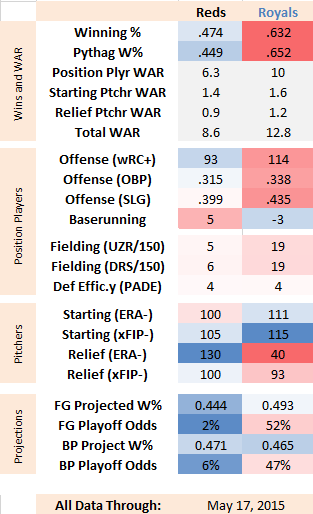
Series Preview: Reds at Royals

To kick off the week, the Reds travel to last year's postseason sweetheart team, the Kansas City Royals for a short, two-game series.  The story on last year's Royals seemed pretty clear: they were a decent, not-great team that squeaked into the playoffs and got hot at just the right moment.  They got a lot of attention for their ability to leverage their excellent bullpen in the postseason, but the real story, for me, was the explosion of their offense in October, which had been below-average all year (94 wRC+).  This year, however, most prognosticators, and most projection systems, expected them to regress back to a 0.500 ballclub.

That clearly hasn't happened.  The Brawling Royals have instead been an offensive juggernaut, tying the Tigers as the second-best offense in baseball behind the Dodgers by wRC+.  They're getting on base, but more surprisingly, they're hitting for extra bases.   Aside from one player, their lineup is virtually identical this year to the 2014 team, which posted the LOWEST home run total in baseball.  They're slightly better this year in that department, but mostly their extra bases are coming in the form of doubles: they lead the majors with 82.  Oh, fun thing: the Reds trail the majors with 38.

If there's a weakness to the Royals, it's their pitching.  Their bullpen has been superb thus far (by results, at least), but their rotation has been shaky.  Some have speculated that they might be a good trading partner for a team that has minimal prospects of making the postseason and viable starting pitching options who are approaching free agency.  Anyone know a team like that?


Position Players

About 5 years ago, the Royals had the best farm system in baseball.  In fact, it was not just the best, but it was described as "the best farm system in recent memory."  Alex Gordon, after several false starts, has turned into a legitimate star.  But two of the other cogs in their plan, Eric Hosmer and Mike Moustakas, were starting to look like busts.  After a good first full season in 2012, Moustakas seemed to be fizzling, and last year was sent to the minors mid-summer in a desparate hope to jump-start his career.  Eric Hosmer was arguably worse.  He had a good year in 2013 (3.2 fWAR), but was otherwise a replacement player (or worse!) in 2011-2012, and 2014.

This year, however, they've been outstanding.  Hosmer is walking for the first time in his career, has a .400+ OBP, is generating tremendous extra base hit totals.  Moustakas will probably never be a patient hitter, but this year has shown dramatically improved contact rates and is spraying the ball to the opposite field 50% more often than in prior years.  Lorenzo Cain, who is perhaps better know for his defense, is also hitting well, and they've been bolstered by a resurgent Kendrys Morales.  The only weak spot in their lineup is Jarrod Dyson, pinch-runner extraordinaire, who is filling in the the injured Alex Rios.  I don't know if this will continue, but thus far the Royals have been a legitimately outstanding offense.

Probable Starters

We only get two games against the Royals, but one, at least, features the fascinating Yordano Ventura.  Thus far in his young career, the 24-year old Ventura has yet to post the high strikeout numbers his superb velocity would seem to predict.  This year, however, he's shown considerable improvement in his ground ball rate, giving him at least one excellent component.  I like him a lot, despite middling results thus far.

Jeremy Guthrie, on the other hand, basically just looks old.  He's never been a good strikeout guy, but he currently has the lowest strikeout rate among all qualified pitchers.  He's also a fly ball machine.  Yeah, he doesn't walk anyone.  Doesn't much matter with those numbers.  If you like high-scoring baseball, the Guthrie/Marquis match-up looks like a dandy.
\
Bullpens

Both teams are currently sporting rather full bullpens due to the fairly restful period in the bullpen.  The Royals' collective ERA has been ridiculous.  Their peripherals have been less so, though I'm pretty intrigued by what former-Red, doomer-of-Chapman-to-Pen Ryan Madson has done.  Wade Davis still hasn't allowed a run, and has been phenomenal.

Reds note: Jumbo Diaz is the only non-Chapman reliever with a sub-100 xFIP-...of course, his ERA- has been brutal.  He's been pitching pretty well, though, aside from the occasional homer allowed.  It's frustrating, as he's getting ground balls at a good rate, and his strikeout-to-walk rates have been phenomenal.