Table of Contents

Saturday, May 13, 2006

Weekend News Roundup/Commentary (5/13/06)

Williams pushed back a day in rotation

Dave Williams is set to pitch today against the Phillies. That's something of a surprise, because it means he was pushed back a day to keep Elizardo Ramirez on schedule. This certainly indicates that Williams will need to shape up in his next few outings to remain in the rotation--and possibly with the big league club--when Eric Milton returns from the disabled list. Given that Elizardo again pitched well, I would not be surprised to see Milton's return mean Williams' demotion. Another possibility would be that Williams could be sent to the bullpen and Shackelford could be demoted. As I mentioned in my BKR profile on Williams, the bullpen might be where he could help us the most. Many pitchers see their ERA's drop by ~1 run upon entering the bullpen.

Denorfia down to AAA; Stratton out

Chris Denorfia was predictably returned to the minor leagues when Griffey returned. McCracken has played well for us and, being a veteran, he could not be sent down without his consent. Therefore, Denorfia was the only guy to go.

To make room for Chris, Rob Stratton was released. I was surprised by this move. According to Redleg Nation's Reds Organization chart, AAA-Louisville had five outfielders: Andy Abad, Alex Sanchez, Brian Buchanan, Norris Hopper, and Stratton. Hopper seems liken an obvious choice for release instead of Stratton, although that could mean that Rob would be sitting on the bench. Perhaps this move was just meant to allow Rob a chance to sign on with another ballclub, as he clearly was below Abad, Sanchez, and possibly Buchanan on the depth chart.

Cole Hamels lives up to hype?

Hamels did go five shut-out innings and struck out an impressive seven, but also was pretty wild, walking five. All things considered, not a bad first-time outing for a young pitcher, particularly against the Reds' powerful offense. I think we'll be seeing him a lot over the next several years. Nevertheless, I can't help but think that many in Philadelphia might be a bit let down by his performance given their high expectations (hat tip to jd at red reporter).

Elizardo was a tough-luck loser yet again. The kid pitched well. I've very pleased with his performance this year.

iBall Reds Marketing Campaign

Daedalus has a great idea for a Reds marketing campaign.

Ground ball pitchers @ Hardball Times

David Gassko has a nice little article investigating the characteristics ground-ball pitchers. You see me harping all the time about how the Reds need to get more guys who induce a lot of ground balls. A big part of this is due to the unique character of the Reds' ballpark. GABP is a neutral park: it is very tough on ground balls (high out/gb ratio), but fly balls become home runs at a high rate. Nevertheless, there are costs and benefits to ground-ball pitchers. Gassko's article reports the following characteristics to groundball pitchers:
  • Lower HR-allowed rate
  • Non-groundballs off of ground-ball pitchers tend to be line drives, not fly balls
  • Groundball pitchers give up far more unearned runs, which may mean that their ERA's are artificially lower than they should be.
Coors Field's use of humidor has lowered its HR-park factor

Speaking of ballparks, Coors' field is infamous for its insane offense. Nevertheless, in 2002, they began storing their game balls in a humidifying room called a humidor. Dave Studeman at the Hardball Times reports that Coors Field's home run's have declined each year since the humidor was installed. Directly from his article, here are the ratios of home runs hit in Coors' vs. elsewhere since 2002:

2002 1.60
2003 1.37
2004 1.23
2005 1.10
2006 0.85

In contrast, he reports that non-HR scoring has not been influenced.

Given all the concerns about GABP's home run friendliness, I can't help but wonder if the Reds should consider installing their own humidor. Granted, Cincinnati already has a more humid climate than Denver, but it might be worth a go. Seems like a relatively cheap way to try to address the problem compared to moving the fences back and such.

Friday, May 12, 2006

Better Know a Red #16 - Aaron Harang

Today is a special day here at OBR. Better Know a Red is sweet sixteen, and we're celebrating by profiling the big ace of the Reds pitching staff, 28-year old Aaron Harang. Harang was drafted and signed by the Texas Rangers in the 6th round of the 1999 amateur draft out of San Diego State University, California. Harang performed well in his first two seasons in the Texas Rangers organization, but was traded to the Oakland Athletics along with Ryan Cullen for Randy Velarde after the 2000 season. After another year in the minors, Harang made his major league debut in 2002, going 5-4 with a 4.83 ERA in 15 starts.

The Cincinnati Reds traded for Harang a year later, sending Jose Guillen to the A's and getting Harang, Jeff Bruksch, and Joe Valentine. Harang immediately entered our rotation, had limited success in 2004, and then took the role of ace (by default) in 2005. There is no other pitcher on our staff that the Reds are counting on more than Harang in this early season. Sure, Arroyo has been hot to start the year, and Milton and Claussen need to turn in good performances for us to compete all summer long. But Harang is the only guy that we have who doesn't need to improve. We just need him to keep throwing the way he did last year. And there's no reason to think he can't do just that.

Additional biographical information (with a humorous slant) can be found in Harang's entry in Red Hot Mama's Human League.

Historical Statistics (for explanations of the statistics used in this feature, please see the Baseball Statistics Quicksheet in the sidebar):
Team IP K/9 BB/9 HR/9 BABIP ERA FIP PERA VORP GB%
2003/OAK-AAA 69.2 7.8 2.2 0.65 0.279 2.71 3.14 4.46 10.5 --
2003/CIN-AAA 3.0 12.0 6.0 3.00 0.444 15.00 6.87 --- --- ---
2003/OAK 30.1 4.8 2.7 1.50 0.326 5.34 5.19 5.23 1 37%
2003/CIN 46.0 5.1 2.0 1.17 0.273 5.28 4.42 4.73 1 48%
2004/CIN-AAA 3.0 9.0 9.0 3.00 0.571 12.00 8.53 --- --- ---
2004/CIN 161.0 7.0 3.0 1.45 0.297 4.86 4.73 4.77 9.1 45%
2005/CIN 211.2 6.9 2.2 0.94 0.293 3.83 3.74 4.03 38.9 40%
Harang is developing wonderfully thus far in his still-young career. 2004 was his first full season in the major leagues, and he showed that he was a guy who could strike guys out at an above-average rate, but could also get beat via walks and the long ball. Last year, when he really broke out, Harang was able to maintain his strikeout rate while dropping his walk rate well below average and getting his HR rate down to league-average. His FIP last year indicated that his 3.83 ERA was no fluke, and may have even been slightly inflated. By the end of the year, Harang's 38.9 VORP proved to be the best by a Reds pitcher since Elmer Dessens' astonishing 7-8, 3.03 ERA, 40.4 VORP season of 2002. In fact, it was the third best Reds pitching performance of the past 6 years, tracing back to Pete Harnisch's 1999 season in which he went 16-10 with a 3.68 ERA (50 VORP) to bring the Reds one win shy of the playoffs.

'03 to '05 Splits:
Category IP K/9 BB/9 HR/9 BABIP ERA FIP
vs. Left 207 6.6 2.6 1.09 0.279 4.30 4.21
vs. Right 241 6.7 2.4 1.27 0.308 4.59 4.48
Home 220 6.6 2.9 1.27 0.287 4.33 4.61
Away 228 6.6 2.1 1.11 0.302 4.58 4.11
Harang has very even splits against righties and lefties. If anything, righties have historically given him a bit more trouble with the long ball, though even that effect isn't particularly strong. His ERA bias has flipped in each of the last three years (in 2005 it favored lefties), though the HR-bias in favor of right-handed batters has remained consistent for the last two years. Overall, I wouldn't worry too much about lefty/righty matchups with the 6'7" right-hander.

Like a lot of pitchers that allow a reasonable number of fly balls, (40-45 GB% last 2 years), Harang's performance does suffer in Great American Ball Park, although his ERA doesn't show it. He allows more home runs there than away from home, though more surprisingly has walked far more batters at home vs. away. Walking hitters in that park is dangerous, as it does heavily favor home runs, even if overall it's a neutral ballpark.

Projections:
Year/Team IP K/9 BB/9 HR/9 BABIP ERA FIP PERA VORP GB%
PECOTA75 204.0 6.7 2.3 1.01 0.288 3.70 3.94 4.06 36.9 44%
PECOTA 199.3 6.5 2.5 1.13 0.294 4.21 4.22 4.50 23.4 43%
PECOTA25 180.0 6.4 2.8 1.20 0.301 4.73 4.44 4.95 10.5 43%
ZiPS 184.0 6.8 2.3 1.03 0.291 4.21 3.94 --- --- ---
While overall, PECOTA and ZiPS do predict a slight decline in Harang's performance this year, they still predict a very solid season for Harang. I'm biased, of course, but I personally expect something more akin to PECOTA75 from him this year. He's only 28, and therefore is still in the middle of the age range in which most pitchers have their best years (~27-30). I've seen nothing in his numbers that suggest he'll decline this season. If anything, he may still improve. One has to remember that last year was only Harang's second full season in the big leagues, so the guy is still learning. If he can maintain the vast improvements in his control that he found last year (and, so far, he has), Harang should continue to be our most reliable pitcher in the rotation.

I just hope he can stay effective long enough that we can surround him with some additional solid pitchers and make a real run at the playoffs. He's the first legitimate starting pitcher we've had since Pete Harnisch. While he might not reach the heights that Harnisch did, and probably isn't what you look for in an ace, Harang has proven to be a very solid pitcher who could be the #2 or #3 guy on most major league rotations. Can you imagine what our rotation would be like without him?

References:
Baseball Archive, The
Baseball Cube, The
Baseball Prospectus
Baseball Prospectus '06 Annual
Baseball Reference
Baseball Think Factory
CBS Sportsline
Fan Graphs
Hardball Times '06 Annual
Minor League Ball

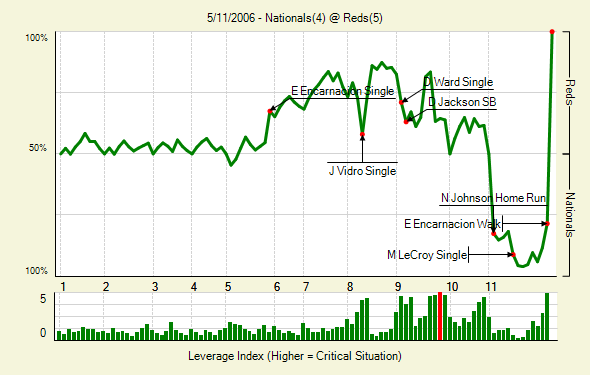
Win Probability Graphs for the May 11th game

Last night's was one of the wildest games we'll see all season, so it's worth taking a look at its win probability graph from fangraphs.com.

WPA tallies of note:

The Good:
Griffey 68.7%
Arroyo 60.2%
Coffey 14.9%

The Bad:
White -45.7%
Freel -23.9%
Weathers -17.7%

Thursday, May 11, 2006

Kenneth is amused at the simplicity of this game

Wow. Griffey is absolutely amazing. This Reds offense is amazing. This game was lost. Lost in horrific and dramatic fashion. And then, with a rally brewing in the bottom of the inning, Freel almost runs us out of the ballgame. But Lopez singles, Eddie walks with a 12-pitch at-bat, and then Griffey arrives. There is no doubt; the man is special. Wow.

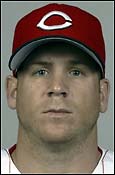
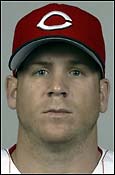
Photo by Jeff Swinger of the Cincinnati Enquirer
Edit:
Was anyone else terrified when they heard that he was being mobbed by his teammates. Don't hurt the leg guys!!! :)

Wednesday, May 10, 2006

Better Know a Red #15 - Ryan Freel

In part 15 of our 25-part series, Better Know a Red, we turn our attention to the Reds' fiery play-anywhere guy, Ryan Freel. Freel was drafted by, but did not sign with the Cardinals in 1994, but was redrafted by the Toronto Blue Jays in the 10th round of the 1995 amateur draft out of Tallahassee Community College, Tennessee. Unlike a lot of the Reds' hitters, Freel did not rise quickly to the majors. After being signed at age 19, he reached AAA at age 22 but then missed nearly all of the '99 and '00 seasons, apparently with injuries. He finally reached Toronto during a brief stint in 2001, but then left the team as a minor league free agent. He signed with Tampa Bay for the 2002 season and spent the entire year in AAA before leaving for the open market once again.

On November 18th, 2003, at age 27, Freel signed as a minor league free agent with the Cincinnati Reds. He was promoted mid-way through the 2003 season and almost instantly became a fixture off of the Reds' bench. Capable of effectively playing all outfield positions as well as second and third base, he brings tremendous flexibility to the team. He also has excellent speed, steals bases at a good clip, and over the past two years has shown a great knack for getting on base via singles and walks. He's the first classic leadoff-type guy the Reds have had since Bip Roberts. Unfortunately, his flexibility has also proven to be a curse, as the team has been unwilling to give him ownership of a position, preferring to use him as a one-size-fits-all plug whenever injuries and other problems arise. Nevertheless, the Reds are counting on Freel to be a frequent member of the starting lineup in 2006, batting lead-off when he plays and serving as the spark plug to this powerful offense.

For additional biographical information (with a humorous slant), please see Freel's entry in Red Hot Mama's Human League.

Historical Statistics (for explanations of the statistics used in this write-up, please see the Baseball Statistics Quicksheet in the sidebar menu):
Year/Team PA PA/K PA/BB PA/HR SB/% OBP SLG OPS GPA EqA VORP
2003/CIN-AAA 238 7.44 11.33 79.33 25/81% 0.336 0.377 0.713 0.245 0.239 -3.7
2003/CIN 151 11.62 16.78 37.75 9/69% 0.344 0.431 0.775 0.263 0.263 5.6
2004/CIN 584 6.64 8.72 194.67 37/79% 0.375 0.368 0.743 0.261 0.268 19.1
2005/CIN-AA 21 4.20 7.00 --- 0/0% 0.286 0.176 0.462 0.173 --- ---
2005/CIN 428 7.25 8.39 107.00 36/78% 0.371 0.371 0.742 0.260 0.272 15.2
Freel has two offensive weapons. First, he has good speed and is an intelligent baserunner. He has stolen between 34-37 bases each of the last three years, all the while maintaining a stolen base percentage above 78%. The cutoff at which stolen bases become unprofitable is ~72%, therefore Freel's production has been a great positive. Baseball Prospectus does complain about him being overly aggressive with his steals, and I will admit that I'd prefer he be more selective about stealing third base. But it's hard to find much fault with his overall numbers.

Second, over the past two years, Freel has substantially increased his walk rate which, in turn, has pushed his OBP into the 0.370+ range. When coupled with his speed, this makes him a tremendous threat at the top of the order. He showed flashes of this sort of OBP in the minors (0.380 at AAA-Syracruse in 2000, 0.372 at AA & AAA in 1998), but it's very pleasing to see him maintain this level of performance in the majors. I wonder if Chris Chambliss deserves any credit for this. He is not one who will hit for much power; he tends to chop the ball onto the ground, which helps him use his speed to get on base (37% of plate outcomes were ground balls vs. 14% fly balls to the outfield). When he does get a ball in the gap, however, he can use his speed to get around to second without the ball even getting by the fielder.

'03 to '05 Splits:
Year/Team PA PA/K PA/BB PA/HR OBP SLG OPS GPA
vs Left 313 7.6 6.8 44.7 0.387 0.415 0.802 0.278
vs Right 849 7.1 10.5 212.3 0.364 0.365 0.729 0.255
Home 585 8.0 9.0 195.0 0.361 0.346 0.707 0.249
Away 509 6.3 8.6 127.3 0.379 0.385 0.764 0.267
Freel is a much better hitter against left-handers. He walks at a much higher rate and shows much better power (though homers are still rare), leading to an 0.800+ OPS over the past three years against southpaws. Nevertheless, he remains effective against right-handers, still retaining a 0.364 OBP against them. I would not be concerned about putting him in against any but the most dominant right-handed pitchers. Like many ground-ball hitters, Freel has not been as good overall in Great American Ballpark as he has been away from home. Nevertheless, this split has flip-flopped each of the last two years, so I think we're seeing some random variation here as well.

Fielding:
Pos. Year Level DI's Dewan+- (plays) Dial ZR (runs) Pinto (runs) Davenport (runs) DP% (+/-)
2B 2003 AAA ? --- --- --- 25 ---
2B 2005 MLB 383 18 9 -0.325 7 -6

Pos. Year Level DI's Dewan+- (plays/yr) Dial ZR (runs/yr) Pinto (runs/27ot) Davenport (runs/yr) Bunt (+/-score)
3B 2004 MLB 392 --- --- --- 7 ---
3B 2005 MLB 69 59 47 --- --- 11

Pos. Year Level DI's Dewan+- (plays) Dial ZR (runs) Pinto (runs) Davenport (runs) DewanHold (% held)
LF 2005 MLB 164 -74 -10 --- 8 5
CF 2003 MLB 165 --- --- --- 0 ---
CF 2005 MLB 101 13 -22 --- --- -11
RF 2004 MLB 265 ---
--- 5 ---
RF 2005 MLB 70 -39 12 --- 0 9

Despite his offensive merits, Freel's primary value to the Reds is his tremendous defensive flexibility. He plays a LOT of positions, and in general plays them very well. The difficulty with this type of player usage from my perspective is that it's difficult to get a decent sampling of defensive innings on him at any given position. Furthermore, since most of the fielding stats I have available are limited to 2005, it's easy to read too much into a particular number.

Nevertheless, I'll draw a few conclusions:
  • Freel seems to be best on the infield. All statistics except for Pinto's probabilistic range model indicate that Ryan has been a plus defender at both second base and third base in each year for which I have data. His only potential downfall my be in turning the double play, where he was involved in 6% fewer double-plays than expected last year given his opportunities.
  • His outfield performance looks to be a bit more average, which for the Reds isn't bad at all. Some statistics rate him as above-average, while others rate him as well below average. All of these numbers are based on a fairly small number of defensive innings, which probably explains why they are so inconsistent. Based on what I've seen from him when watching games over the past few years, Freel seems to have the speed to generate excellent range, but tends to get fooled on balls hit out there now and then. I'd bet that if he were played out there for a full season, he could become a very good outfielder. His arm seems to be roughly average (I write this on an evening in which Freel threw out a guy at the plate from center field).
Projections:
Year/Team PA PA/K PA/BB PA/HR SB/% OBP SLG OPS GPA EqA VORP
PECOTA75 479 7.26 9.58 95.80 33/77% 0.357 0.369 0.726 0.253 0.261 10.9
PECOTA 470 7.12 10.00 117.50 31/78% 0.344 0.351 0.695 0.243 0.251 6.2
PECOTA25 395 6.81 10.97 131.67 24/80% 0.320 0.318 0.638 0.224 0.232 -5.0
ZiPS 470 7.23 8.55 117.50 32/74$ 0.364 0.366 0.730 0.255 --- ---
The projections all predict a fair decline for Freel this year, although ZiPS is kinder than PECOTA. The latter predicts a drop in his OBP from the 0.370's into the 0.320-0.357 range. While he would still retain some value, particularly with his speed, such a decline in OBP removes one of his two primary weapons. The primary cause is the prediction that his walk rates will decline back to numbers more similar to those from his '03 season. I see no reason why this should happen. Freel increased (albeit slightly) his walk rate last year and has had two consecutive seasons with an OBP over 0.370, both years with ample playing time. I fully expect him to repeat this performance this year; at 30 years old, Freel still should at the very least have a year or two left at this level of production.

Part of the problem with PECOTA may be that Freel doesn't have a lot of highly comparable players. While his overall similarity score of 54 is reasonably high, his most comparable players in PECOTA are Keith Miller and Bobby Adams, neither of which had a season in the 0.370 range, much less two consecutive such seasons. Therefore I think these projections just don't have him gauged well. If Freel has a third 0.370+ OBP season this year -- and I expect that he will -- I think we'll start to see a bit more respect for the guy from the analysis packages.

The biggest question I see in Freel's future with the Reds is not his performance, but rather (as always) his playing time opportunities. With Griffey being out most of this early season, Freel's gotten a lot of innings out in center field -- perhaps too many, as his offense has declined dramatically the last couple of weeks. However, once Griffey returns, Freel will seem to be back to taking playing time where he can get it. Second base is no longer available unless Phillips continues to struggle, and occasional starts there and at third will be hard to come by, especially after Aurilia returns. Narron's pretty good at juggling his lineup to keep his chief bench players sharp, but Freel may have to wait until the next injury to get another decent streak of playing time.

References:
Baseball Archive, The
Baseball Cube, The
Baseball Prospectus
Baseball Prospectus '06 Annual
Baseball Reference
Baseball Think Factory
CBS Sportsline
Fan Graphs
Fielding Bible
Hardball Times '06 Annual

Daily Graphing on Dunn

Fan Graphs.com has posted a Daily Graphing feature on Adam Dunn in which they try to forecast Adam's season--they see big things on the horizon for Cincinnati's giant of a first basem...er...left fielder:
That huge strikeout total is a harbinger of a down year, right? Nope — all other signs point to a career year. Dunn is walking more often (21% of PAs), he’s hitting fewer groundballs (32%), more line-drives (22%), and a lot fewer infield flies (6% down from last year’s 14%). Even if you’re worried about the strikeouts, feel confident that the increased walks will result in a career best walk-to-strikeout ratio (BB/K).
While I don't do it nearly enough, I often find that new insights can be gained by looking at data in graphical form. One of the biggest merits of the fangraphs website is that they make it easy for folks to take a graphical look at any players' numbers. If you haven't yet checked it out, please go do so.

Edit: If you're feeling Dunn-giddy after reading that, you'll have to go over to Red Reporter and check out the Adam Dunn video. Nice to see some of the great defensive plays the guy has made over the years. I think the first one was from this year's opening series vs. the Cubs.

Monday, May 08, 2006

Off-Day News Catch-Up, Part Deux

BP's Goldstein on Travis Chick
Kevin Goldstein profiled young AA-Reds prospect Travis Chick in his Monday Morning Ten Pack today. Excerpt (is it an excerpt if it's the whole bit?):
For the briefest of moments in 2004, Chick was flavor of the month in prospect land, putting together seven monster starts (2.13 ERA, 55 strikeouts in 42 innings) for Low-A Fort Wayne after being traded from the Marlins to the Padres in a deal for Ismael Valdez. The Padres jumped the then 20-year-old Chick to Double-A to begin 2005, and it proved to be an overly-aggressive move, as Chick struggled with his command and began to press, which led to issues with his delivery, which led to lower velocity, which led to more problems. After putting up a 5.27 ERA in 19 starts for Double-A Mobile, Chick was included in another trade, going to the Reds as part of the Joe Randa deal. So now he's 21, in his third organization, and back in Double-A, and Chick has reeled off four straight starts allowing two or fewer earned runs, something he never accomplished last year. If you were a young pitcher looking for a chance, Cincinnati could be the ideal organization. He's not coming up anytime soon, but a major league debut sometime this season is within reach.
I'd personally be mighty surprised to see Chick in a Reds uniform this September, but you never know. Nevertheless, I'd guess the more likely (good case) scenario is that he makes AAA by mid-late season, and then arrives in the big leagues near the end of the '07 season.

The Randa transaction--both signing Randa and then trading him to the Padres--is easily O'Brien's best set of moves. Getting two possible big-league starting pitchers (the other being Justin Germano) for a half-season rental of a guy like Joe Randa was a very impressive feat. Sure, he'd been hot in the first half, but Randa had only had one 0.800+ OPS season in the previous five years. Outstanding work. I almost feel guity.

What kind of Reds fan are you?

Red Hot Mama has released a highly scientific survey that determines exactly what sort of Reds fan you are. I scored as a "super fan." I'm a little disappointed that I didn't score higher, but I lost points on the "what is the happiest moment of your life" bit. Somehow the Reds winning the World Series was left off the list of options. I mean, heck, it was the defining moment of my childhood... :) So I had to settle for getting married. Kid being born might top it, but that's still a couple of weeks off yet...

Chris Chambliss, Reds Hitting Coach Extraordinare
The Enquirer had a nice article on Chambliss, the Reds hitting coach, and the job he's done with Reds hitters. They talk about his emphasis on being "aggressive but patient." This sounds a lot like what you hear from Oakland player development people. Waiting to get a good pitch, laying off pitches you can't hit, sitting on pitches you can hit early in the count, and having a good two-strike approach. Nothing revolutionary, but it's a tried-and-true approach that will work for a lot...not all (e.g. Vladimir Guerrero)...but a lot of ballplayers.

Chambliss's work with Dunn was particularly notable a few years ago, but this is the first time recently I've seen some credit given to him for the effectiveness of the Reds' hitters. Of particular note is how a number of hitters have come to Cincinnati and attained a renaissance over the last few years. Randa, Aurilia, Lopez, Valentin, and this season Hatteberg and Phillips. A lot of the credit has to go to the hitters themselves, but some must go to their coach.

Thanks to Red Hot Mama for helping me notice this article.

Baseball Prospectus on the Reds' Start
Baseball Prospectus had two articles that discussed the Reds' start last week. The consensus view is that the Reds are probably better than a lot of people gave them credit for at the season's beginning, but they're probably not as good as they have been thus far. That's pretty much my view as well. They examine a number of statistics to argue their case, but frankly I think it's too early to read much into rate-based statistics. Besides, while in my heart I know the Reds are probably going to slip, I'm still very excited about this team and the prospect that they could have a winning season. Maybe not a playoff-bound season, but they absolutely can win more than they lose.

The Effect of the World Baseball Classic on Pitchers
Nate Silver posted a really interesting article on the '06 regular season performances of pitchers who threw in the World Baseball Classic this spring. He notes that there was no WBC team on which the pitchers have (on average) performed better than their PECOTA projections this season. Excerpt:
These are very disturbing numbers. The relievers have emerged relatively unscathed--sixteen of the thirty-two relievers in our study have outperformed their PECOTA, and sixteen have underperformed it. But the starting pitchers have been brutalized. Nineteen of the 26 starters--nearly three-fourths of our sample--have underperformed their PECOTA. In most cases, they haven’t even come close to their projection. The weighted average ERA for the WBC starters is 5.49, a buck and a quarter higher than their PECOTAs. Keep in mind that these are supposed to be, quite literally, the best starting pitchers in the world, and that this performance has come over hundreds and hundreds of collective innings.
His hypothesis to explain this phenomenon is not that the WBC pitchers were overworked, but rather that their spring routines were disrupted by the WBC.

This is the first empirical evidence that I've seen indicating that the WBC affected player performance in the regular season. And frankly, I'm not surprised by it. Now as some may remember, I was a huge supporter of this tournament. But I also recommended some pretty substantial changes be made to it, the most important of which had to do with the scheduling. The spring simply didn't work. Major League players were not ready for competitive baseball, it interfered with spring training, and perhaps even worse in terms of press coverage, it overlapped with the NCAA Basketball Tournament. It's just really bad timing. I realize that it's not realistic to try to hold it mid-season (though I'm not sure that it's as impossible as Bud would have us believe--especially if the all-star game was cancelled and that break expanded), but I've not been at all convinced by the arguments against holding it after the season. These are (based on Bud Selig's comments in innumerable interviews):
  • Players are beat-up after the end of the season: yes, some are likely to be tired and/or hurt, but most will have had several weeks off during the playoffs. Giving the World Series players a week or two off prior to the WBC tourament start seems as though it'd be enough time to recover and be ready to play, to me at least. I think this is less of a problem than having players who are rusty and still trying to find their swings and pitching motions in the spring.
  • Players will have gone home after the season on non-playoff teams: so what? I see no reason why a player wouldn't be willing to take some time off and then head out to the team camp to start praticing. You could even start the WBC team camps during the playoffs to let the players start working together and meshing as a team.
  • All the players that Bud Selig has talked to say it's a bad idea to hold it after the season: I've heard Chipper Jones, at least, specifically say that the tournament needs to be held after the end of the season when all the players are sharp and ready to play. After their experiences this year, I have little doubt that a lot of players will agree with him.
Edit: I can also think of one very good reason that they should hold the tournament after the end of the season. It would give both players and fans of teams NOT involved in the playoffs (particularly those that know by mid-season that they aren't going to be in the playoffs) something to look forward to that baseball season. It would have meant a lot to me if, last year, for example, we knew that, come November, I'd have a chance to see Griffey, Pena, Valentin, etc, on teams that could potentially win the Classic. That'd be a real thrill.